
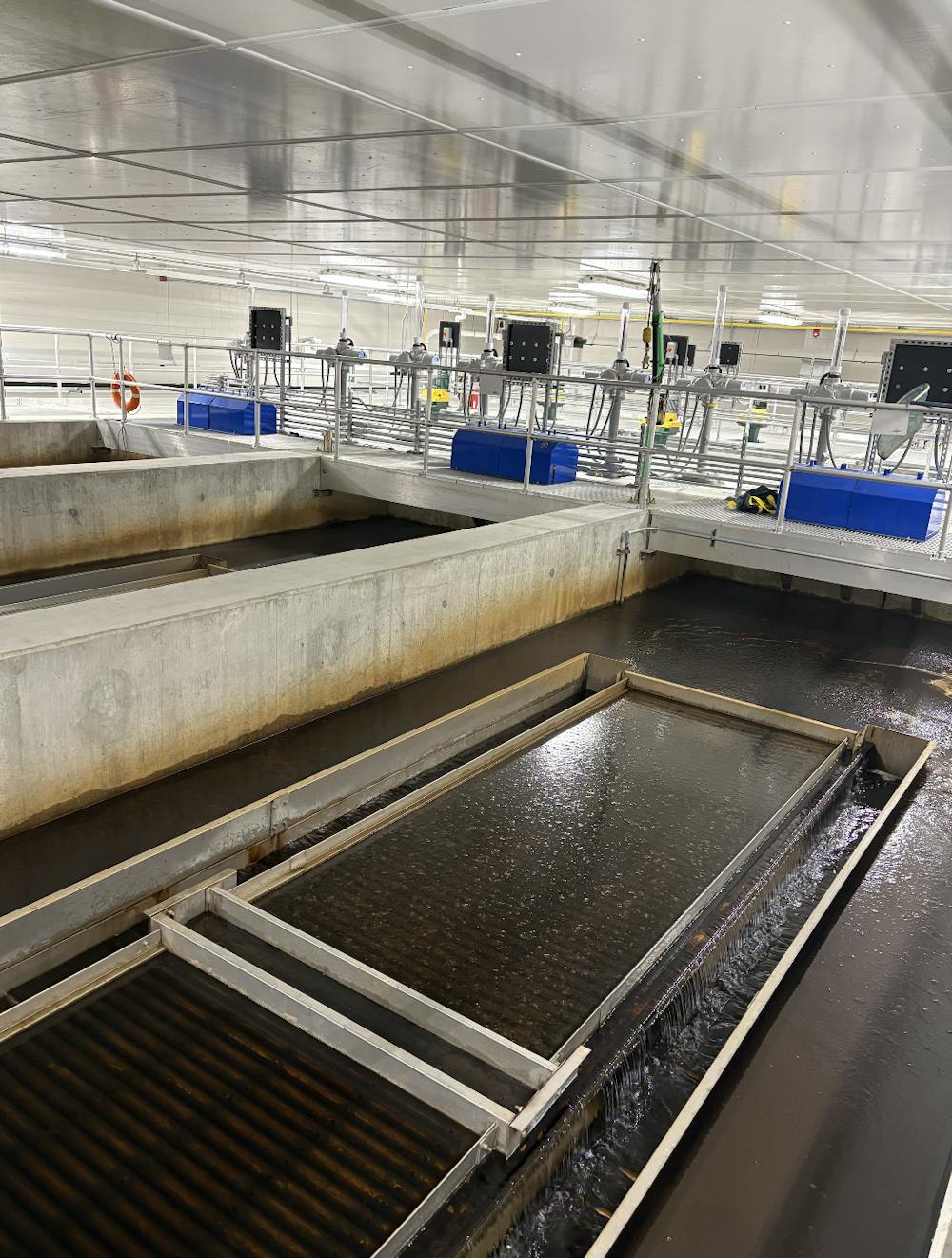
Brisk, November water from the Lamprey River is pumped into the University of New Hampshire and Durham Water Treatment Plant, and within a day becomes clean, drinkable water. But it’s not so simple. Through treatment, the water is taken from the Lamprey River, the Spruce Hole Aquifer, or the Oyster River, and transformed.
Water treatment isn’t something most people think about, yet clean water remains one of the most essential pillars of everyday life. Reliable access to safe drinking water allows elderly residents, adults, children, and even pets to live healthier, longer lives without the hidden risks that long-term exposure to contaminants can pose.
According to Associate Professor of Civil and Environmental Engineering and the Principal Investigator of UNH Stormwater Center, Thomas Ballestero, “There’s a lot of unmanaged runoff that goes into College Brook, and there used to be, for example, a lot runoff by the horse paddocks along Main Street and that would generate a lot of nutrients unless they were managed properly. So there’s a lot of activities that, historically, were unmanaged that UNH is slowly trying to manage.”
The UNH and Durham Water Treatment Plant, completed on March 11th, 2020, is a massive step-up from the prior treatment facility that was built in 1935 and utilized water from the Oyster River. The new plant is located at 28 Waterworks Road, two buildings behind the UNH Police station.
“There was no centralized water system at the University here, and effectively, the town and University decided they needed to secure a solid future with their water supplies,” said Michael Sullivan, the primary operator of the UNH and Durham Water Treatment Plant and project manager for Woodard & Curran, the engineering team that supports and operates the plant on campus, “We were the oldest operating treatment plant in the state without a major upgrade before 2020. The goal with this new plant was to add an extra ‘N plus one’, so our needs plus an extra unit for redundancy.”
The new plant is a complex web of protocol, guidelines, and scientific advancements to keep the water clean and sustainable. UNH’s groundwater and surface water sources undergo testing and treatment at the Water Treatment Plant before it reaches campus and the town. The water sources are filtered to remove naturally occurring minerals and sediments.
For UNH and Durham, the Lamprey River leads as the major surface water source. Groundwater and surface water are globally reliable sources for drinking water, though at the start they can contain contaminants like nitrates, volatile organic compounds, and minerals that have to go through a treatment process.
The treatment process consists of five steps; coagulation, flocculation, sedimentation, filtration, and disinfection. These precise steps lead to the clean, clear, and safe water that the UNH and Durham community rely on every single day. Treatment simply starts from choosing what sources may not be the best, even if they are easily accessible.
“With the Spruce Hole, we originally blended it with the Oyster River water, which is our third source and the original source associated with this system. We don’t have any restriction on Oyster River, it's the only source we have that's not regulated,” said Sullivan, “The problem with Oyster River water is that it has a high amount of groundwater infiltration and what happens with that groundwater is that it usually has manganese associated with it that we then have to treat. It’s a source of last resort for us, we don’t want to be on that source if we can avoid it.”
Every day at the UNH and Durham Water Treatment plant means working towards a more sustainable future for water in the community. One of the biggest accomplishments of this year, according to Sullivan, is the artificial recharge designed for the Spruce Hole Aquifer. Another being the determination to minimize water loss annually.
“We wanted to optimize the artificial recharge system with the goal being to add this reliability in the resiliency of the system,” Sullivan said, “We applied for a grant, we received the grant, and the first item on our list was evaluating the water loss. We had about 12.8 million gallons a year of water loss.”
Much of that lost water came from a drain line at the Oyster River Footbridge near the dam, which previously had to be opened from December to April. To fix this, Sullivan installed a temperature sensor on the backside of the building and added an automated valve tied to new SCADA programming, allowing the line to drain only when the plant is off and temperatures drop below a set temperature. This new automated valve has eliminated roughly 90 percent of the 12.8 million gallons lost each year.
Sullivan and his team reached yet another major milestone this year by preparing the Spruce Hole Aquifer to be rapidly recharged in an emergency. The aquifer had a maximum capacity of 63 million gallons of water used per year, which means a supply of about 1.044 million gallons a day. This amount shrinks fast when the town uses nearly half a million gallons of water daily, especially if the primary source, the Lamprey River, were ever offline.
“We did something so cool this year, seven years into the project,” Sullivan said, “We installed all new automated valves that allowed us to recharge both the upper and lower recharge basin. We also put a check valve on the well itself to protect the well from water moving in the wrong direction. And then we did a lot of SCADA control work so we can operate it right here from the plant. This has allowed us to rapidly recharge if we wanted to. We could recharge the Spruce Hole Aquifer up to the full flow of the Lamprey River if we needed to.”
Durham’s progressions in water quality and water treatment reinforces a statewide commitment to protecting drinking water, as New Hampshire continues to expand its monitoring and treatment efforts to ensure contaminant levels stay far below federal standards and communities remain protected and informed.
In New Hampshire specifically, the discovery of a contaminant known as per- and polyfluoroalkyl substances (PFAS) from firefighting foam at Pease exposed a growing global concern and required urgent research into water treatment solutions. Though, there is no connection between the contamination at Pease and the UNH and Durham water.
According to the United States Environmental Protection Agency (EPA), the discovery of PFAS at Pease occurred in 2014 and refers to the dangerous levels of PFAS found in the public drinking water. Firefighting foam used during training exercises at the Pease Air Force Base was the source of the contamination.
“This was 2014, and PFAS were not on anybody's radar, certainly not New Hampshire. So Portsmouth, Pease, was the first water system in New Hampshire to be impacted. We shut that well off, that was what we were doing to try to resolve it. And it was unbeknownst to me, or just about anybody else, how big of an issue this would become. Because now it’s everywhere,” Brian Goetz, administrator for the Rye Water District stated.
The firefighting foam contained specifically perfluorooctane sulfonic acid (PFOS) and perfluorooctanoic acid (PFOA), and was the first time New Hampshire dealt with an occurence in PFAS which led to the now careful testing and monitoring of those levels all over the state.
“Groundwater treatment will continue at the site and focus on the migration and treatment of the PFAS contamination that has been discovered in groundwater monitoring and private drinking water wells…” the EPA Superfund site stated, “...the Air Force is conducting a comprehensive environmental investigation to determine the full nature and extent of these same contaminants in the environment on and off the former Air Force installation along with a detailed assessment of potential risks posed by this contamination to human health and the environment.”
Scientists and researchers all over New Hampshire want to emphasize the need to test and treat private wells, especially in places like Durham and local communities. Over half of the residents in New Hampshire get their drinking water from private wells, which are not regulated in the same ways public water systems are. In most places, owners of private wells are responsible for their own testing. The New Hampshire Department of Environmental Services (NHDES) is an organization that provides guidance and recommendations for testing.
“Based on the map of Durham, it does look like a good portion of Durham residents get their drinking water from private wells,” the Administrator of the Environmental Health Program at NHDES, Karen Craver stated.
According to UNH Civil and Environmental Engineering professor, Paula Mouser, “UNH and the Town of Durham own and pay for operation of a public water supply that is permitted and regulated under the safe drinking water act. So, they deliver very high quality drinking water to residents and campus.”

This dedication to providing safe drinking water is reflected in how the UNH and Durham Water Treatment Plant is regulated. Based off of data from the Consumer Confidence 2025 Water Quality Report on the UNH-Durham Water System, the maximum contaminant level (MCL) for the different types of PFAS ranges in regulation from 18 parts per trillion (ppt) to 11 ppt with all levels in the UNH Plant found to be no higher than 3.19 ppt as of their last testing period.
According to the Director of the New England Water Treatment Technology Assistance Center, Dr. Robin Collins, “With the Safe Drinking Water Act, you have to meet certain standards. If not, the town is required to treat to remove it [contaminants]. There are towns being required to treat for PFAS. Using activated carbon is very common. But in theory, if you stay below the maximum contaminant level, the target is roughly one in a million chance of developing cancer if you drink, say, two liters of water a day for 70 years.”
According to Collins, activated carbon filtration helps to remove contaminants like PFAS and volatile organic compounds from groundwater sources.
Scientists, engineers, and operators continue to monitor water quality daily, weekly, and annually to ensure that all regulations from the Safe Drinking Water Act and standards set by the NHDES and the EPA are met. New Hampshire sets stricter standards for PFAS and other contaminants.
“We take what EPA sets as drinking water standards and implement those at a minimum and sometimes we do things a little bit more restrictive that would be appropriate for us,” said Jennifer Rzepka, NHDES sanitary engineer for the Drinking Water and Groundwater Bureau, “So things like PFAS, the EPA standard was higher for a while and because there was a lot of PFAS contamination in New Hampshire, we decided to have a lower standard for our state because there's a lot more exposure for our residents. So there’s things like that where we get a little leeway through the rulemaking process to implement higher standards than what the federal level has.”
With synthetic contaminants such as PFAS or naturally occurring contaminants such as arsenic, there is another layer of research done to see the possible health effects if a contaminant exceeds maximum contaminant levels.
According to Craver, “Environmental quality standards play a critical role in protecting public health by minimizing exposure to harmful contaminants. Enforcement of these standards not only ensures that public water systems deliver clean and safe drinking water, but environmental quality standards also guide risk assessment and drive remediation efforts, ultimately helping to prevent and reduce environmental exposures.”
The 2025 Consumer Quality report states that PFAS exposure over the maximum contaminant level over a span of years can lead to problems with the liver, endocrine system, or immune system. This exposure can also impact women’s chances of getting pregnant, and increase the risk of getting certain cancers.
New Hampshire monitors a wide range of contaminants beyond PFAS, some of which can carry serious potential health risks. Certain radioactive elements, like radium, have been linked to cancer. Inorganic compounds such as barium can affect blood pressure, while organic carbon and microbiological contaminants can cause issues with the nervous system, liver, or kidneys. And then there’s E. coli, a recognizable name for many people, which can cause symptoms like headaches and nausea within hours and is especially dangerous for children, older adults, and pregnant women.
“Understanding the health risks of different contaminants is an important step for recommending limits in groundwater or drinking water that are protective of human health. It involves a lot of research into scientific studies that have been published on the health risks of the different contaminants, especially for sensitive populations like children or pregnant women,” NHDES Toxicologist, Kimberly Aviado stated.
If drinking water is never tested, the contaminants can go unnoticed, which introduces health risks to individuals and communities. PFAS has no odor, no color, no taste, and the only way to know if there is contamination is to test. Other contaminants that pose risks to New Hampshire include arsenic, radon, nitrates, lead, fluoride, uranium, and E. coli, and also go undetected without testing.
More than half of the residents in New Hampshire rely on private wells where contaminants can go unnoticed without testing. According to Craver, “Private wells are not regulated, and all owners are responsible for testing and treating their water if they choose to follow recommendations.” The water treatment performed by the UNH and Durham Water Treatment Plant would unfortunately not have any impact on those private wells.
The operators, engineers, and researchers in Durham maintain a safe, reliable water supply with constant room for advancement. Clean drinking water may seem simple, but in the UNH and Durham Water Treatment Plant, it’s the product of a commitment to protect the communities that depend on it.


