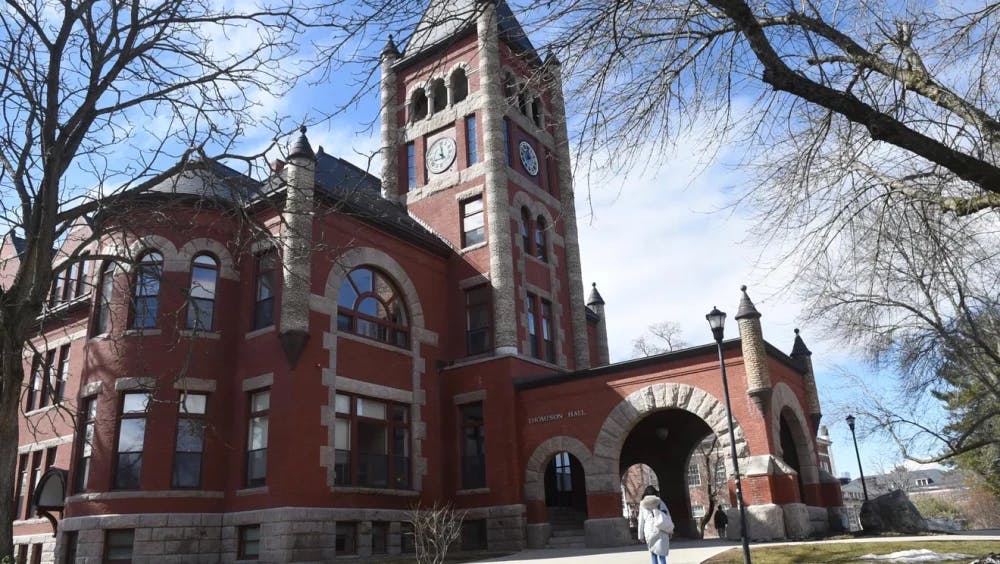
On Feb. 5, 2026, State Representative and UNH Senior, Samuel Farrington (R-NH), ’s Campus Carry Bill, House Bill 1793, passed through the New Hampshire House with a 188-165 vote. If passed through the Senate and signed into law, it would prohibit public colleges and universities across New Hampshire from banning or regulating the possession and carrying of firearms and non-lethal weapons on campus. This bill would go into effect on Jan. 1, 2027.
Public institutions such as UNH, Keene State College, and Plymouth State University currently have gun-free policies. Farrington’s bill would prevent the enforcement of these policies, and individuals could also sue these institutions over $10,000 for restricting the carrying of weapons on a public campus.
Farrington says that right now, there is no law that prevents students from walking around campus carrying a firearm. “The school just uses their policy to really threaten kids that dare to do it, and they would use disciplinary action, but they can't charge them for any crime,” said Farrington.
Elliot Boutin, fourth-year student, and State Chair of New Hampshire's Young Americans for Liberty (YAL) chapter, noted that under New Hampshire law and the Second Amendment, every individual’s right to self-defense is protected, and does not disappear when you walk onto campus. “Personal safety and constitutional rights go hand in hand. They’re not competing ideas,” said Boutin.

Representative Heath Howard (D-NH) worries that allowing the carrying of firearms on public universities across the state would stop raising questions as to what an individual is doing with a firearm, which could be detrimental in a nation with the highest rate of mass shootings in the developed world.
Howard said, “It makes it a lot harder for law enforcement to discern who is the victim, who is the perpetrator, and it makes it harder for them to respond in a timely manner.”
In the instance of an active shooter situation on campus, a UNH professor predicts that a shooter could easily get off 180-200 rounds in three minutes. He said the UNH Police Department's response time is around 90 seconds, which he sees as optimistic. Thus, he believes that if there is someone armed, trained, and capable in the room, a significant number of lives could be saved. “Denying trained people the right to exercise their constitutional rights to address threats like this is just as irresponsible as the opposing argument,” said an anonymous UNH professor.
Many students across campus feel passionately about this issue; both supporters and opponents of the bill have created online petitions that have received hundreds of signatures.
UNH graduate student, Bella Foltz-Smith, said, “My first thoughts when I learned about this bill were disbelief and denial. I couldn't possibly fathom New Hampshire taking this seriously. Bringing in more guns has never curbed gun violence.”
UNH Senior English Lecturer, Lawrence Beemer, supports the Second Amendment but also expressed distaste for this bill and believes that if passed, it would have an immediate negative impact on the students and staff at UNH. “A firearm is a tool that has no appropriate use in an educational environment, and I, for one, will find it difficult, if not impossible, to carry out my job with guns in my class,” said Beemer.
Rep. Farrington stated that from his research, he found that 92% of all mass shooting incidents occur in these “so-called gun-free zones.”
“So all that these policies do is prevent the good guy from putting up a fight against the bad guy, and so it leaves victims as defenseless and hopeless,” said Farrington. He also believes that if an individual wants to commit evil and is aware that people in a certain area could be armed, they will be deterred by that fact.
Representative Wayne Burton (D-NH) spoke against HB 1793 in his floor speech on February 5 and said, “Our new 600-student middle school sits right behind fraternity row on Madbury Road. Many kids walk by them and through the campus, coming and going to school. I live a quarter mile from T-Hall, in earshot of social events on the weekends. I don’t want to hear gunshots.”
Rep. Howard described how the fatal shooting of Charlie Kirk at Utah State University in September became such a dangerous situation because Utah is a campus carry state. From discussions with UNH students about this issue, Howard has found that a vast majority of them are very opposed to this legislation.
“I understand that you might not like guns, or might have a sense of uneasiness towards guns, and that's okay,” said Farrington. “But when somebody chooses to bear arms, that's a personal decision, and the overwhelming majority of people who choose to carry day to day are responsible individuals. And what it comes down to is that this is a constitutionally protected right.”
Beemer said, “I don’t think this even really qualifies as a Second Amendment issue; it’s just needling against common sense. It’s legal to own a llama, but it would be disruptive to bring one into class. One shouldn’t need a law to understand that.”
Regardless of individuals’ viewpoints on this issue and this bill, Farrington said that safety is definitely a concern on campus right now, and people just want solutions.
Since the Campus Carry Bill has now passed through the House and was referred to the New Hampshire Senate on February 9, politicians and advocates predict the hearing will occur in the coming weeks. If the bill makes it through the Senate, it will arrive at the desk of Governor Kelly Ayotte, who will then decide whether to sign HB 1793 into New Hampshire law.