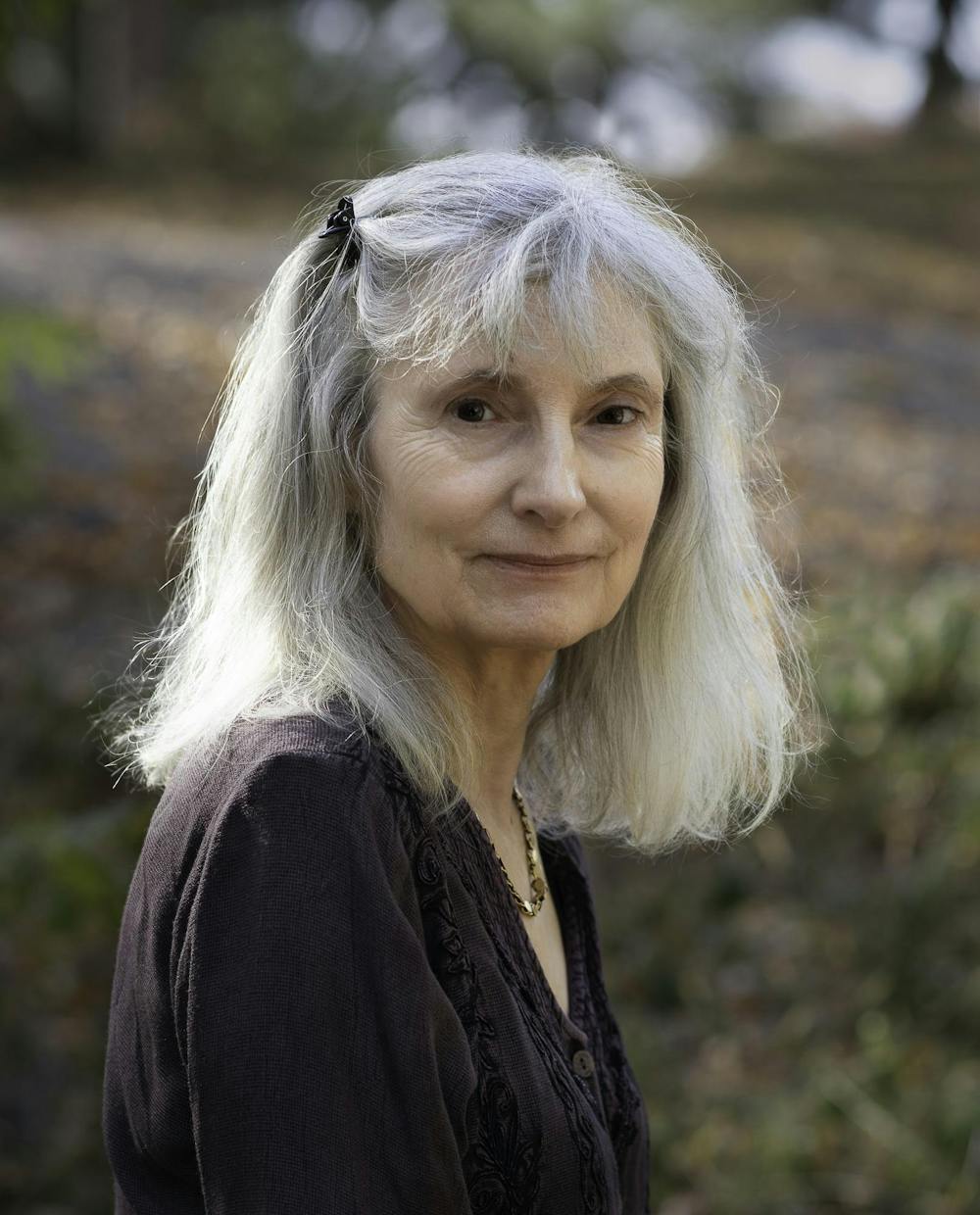
Rosanna Warren is a Connecticut-born poet, essayist, translator, biographer and former educator with a catalog of more than seven collections of poetry and literary criticism published throughout her esteemed career. Warren devoted as much time to her creative endeavours as she did teaching literature and the English language at numerous institutions, ranging from universities to Massachusetts medium-security prisons.
A day before she read at the first of UNH’s Writer’s Series for the 26-27 academic year on Sept. 17, I was fortunate enough to be able to speak to Rosanna Warren for an exclusive interview.
The following is a modified version of our conversation for brevity.
It's an absolute pleasure to speak with you. How are you?
That's a serious question these days, considering the country and the world. I take very seriously that we care about how we are. So I’m surviving.
You’re reading at UNH tomorrow. As a deeply established poet, what compels you to do a reading today?
It’s not advertisement. It's about sharing. It's about giving the work a life in the ear, in the eye, in the consciousness of potential audience, so it can have a life there.
You started as a painter when you were attending Yale. Has being an experienced poet changed the way you engage with other art forms?
I've been doing this for about 50 years. It’s all incremental and it's all come under the title of experience. I still do some drawing and listening to music, which is important to me and enters my experience of poems as well. I think the arts feed each other and live off each other in a good way. For instance, the music of Stravinsky and the music of Shostakovich matters to me in many ways, but partly because those are composers who push their art forward through forms of dissonance, which is what I'm trying to do in my poems. I come out of deep metrical traditions, and yet I'm also steeped in modernism and free verse. It’s about trying to marry those traditions of metrical order and dissonance.
You put out a collection last year. Hindsight. How did that come together? What does it take for a collection to feel complete?
That's a compositional question. In a sense, it just expands the attention one brings to an individual poem. What is the internal order and is it ever finished? It's about slowly groping one's way to a sense that a group may be coming together, cohering. In Hindsight, there are poems that were written during the COVID years, when my beloved and I lived in a very ramshackle shack up in the Catskill Mountains. Some of the poems were reflecting concerns—that's a mild way of putting it—and anguish at a country that was certainly in a very self-destructive state. So, part of the coherence of Hindsight is that not all the poems are overtly political—in fact, probably many of them you wouldn't think on the surface were political at all, but there's, underneath it, a deep political concern. What is the polis? What does it mean to be a citizen together? So that's part of the character of this book—mourning and anguish. But because some of these poems, many of them, were written when in a period of seclusion in the country, they're also full of nature. I grew up in the country, so I had always had a feel for animals and plants and the surround. But now with our ecological emergency, a planetary emergency, these poems that commune with nature, meditate on nature, have to me a more urgent character.
It seems like Hindsight is a book largely about disconnect in a lot of ways.
That's a really interesting comment. I accept that. And just to support it, the book ends with a poem called “Equinox,” which moves between the forest scene in the Catskills to a memory of the city, where the speaker of the poem remembers this figure who came out of the shadows of a hotel parking lot on a cold winter night. This young man was partly naked, and this encounter ends with disconnection. The last two lines of the poem, which are the last two lines of the book are “‘in our being, god is torn,’ said Simone Weil, ‘we walked away not in his world.’”
That’s a powerful image. Is this path to understanding your world through poetry still a journey you find yourself on?
Oh, yeah! I mean, I never even wanted to write poems. I wanted to be a painter, but writing eventually took over because I was writing all the time from childhood on. I simply cannot understand my life without poems. I do not understand things. So I need the poems. I need the struggle on the page to try to figure something out.
That dissonance that you were referring to, has it evolved over time? Has it changed as to why you've written in that kind of form?
Well, of course, because life changes. The world around you is changing. The world before 9-11 for Americans was different from the world after 9-11, just for one example. When The United States attacked Afghanistan and Iraq disastrously, I was trying to write poems that addressed the war, and I found that I could do it best obliquely. I did it through poems about Homer, poems about The Iliad. I did it through poems about Virgil, The Aeneid, the violence and birthing of the Roman Empire. So, my poems have been thinking about such matters for a long, long time, but in different ways and different languages.
The cyclical quality of our species—how does that play into what you write about?
Poetry is not journalism, nor is it an op-ed article. I didn't want my poems to sound like, “oh, I'm outraged we've attacked Iraq.” What we need is imagination. What poetry gives us is the deep imagination, of what is it to be at war? What is it to die? What is it to kill? And for that, I think we need Homer. We need The Odyssey. We need Gilgamesh. And then you make up your own list. But that's what culture is. It's finding imaginative and spiritual resources in order to interpret what's going on right now. Because it's really hard to interpret the present. It's really hard. It's blind man's bluff. It's very hard to see what's happening.
You lived in both Italy and France, and have devoted a large chunk of your career to the art of translating. How did those experiences transform your art and your perception of art as a whole?
It’s so enormous that I can't even measure it. I often told my students who wanted to be writers in English, “you need to start treating the English language like a foreign language.” You need detachment from it because you need to have more critical perspective on your own unconscious assumptions—about grammar, about vocabulary. A fundamental way to do that is you learn other languages. And by learning other languages, you're learning not just different words for things, you're learning different structures of reality. You're learning a whole different prosody. And that's important, to open your ear so you're not stuck unconsciously just reproducing whatever happens to be the pop song of the day, or the latest poem in the New Yorker or the APR. You need critical, artistic, aesthetic distance in order to create something real, I think.
You have a book coming out in December, do you want to say anything about it?
Yes, it's a family memoir. It's a book I resisted writing for many decades because my parents were well-known writers and I didn't want to be living off of their names. But they’ve been dead a long time and there were some stories I did want to tell about the life of writing. Their lives. So I had published a few individual essays about my mother's work and my father's work. And then they seemed to be tending toward being a book.
What does your day-to-day work look like for you now?
That's interesting. Part of it is homework and clerical, but serious in helping younger writers and scholars. This is the season when you write recommendations for grants. I think a lot about the person I'm writing for and what they've done and why I think they should get a grant or a job. That's not the main part of my work, but it's part of being a collective— to feel like we’re not alone, connected to one another. Since I'm not teaching anymore, I have a lot more time to sit in my chair that I call my poetry boat. I write by hand, and I write in my notebooks and muddle and struggle and try to make shapes come on the page. And sometimes they don't. Mostly they don't. Sometimes they do. And there's a lot of reading. It’s a sort of weaving of literary endeavors.
Do you have any advice for the up-and-coming poets, who, quite possibly will be the defining poets of this generation?
‘Don’t let AI write your poems’ would be my main piece of advice. Don't get your brain invaded by capitalism to that extent. That's half serious…but actually, it is serious. Read…because I have met some younger poets who don't read very much, and I think that's a self-defeating, anti-artistic way to proceed. Don't just read your contemporaries and try to pick up their dance steps. Read the deep past. See what you can make of that. That's the way to be original.