
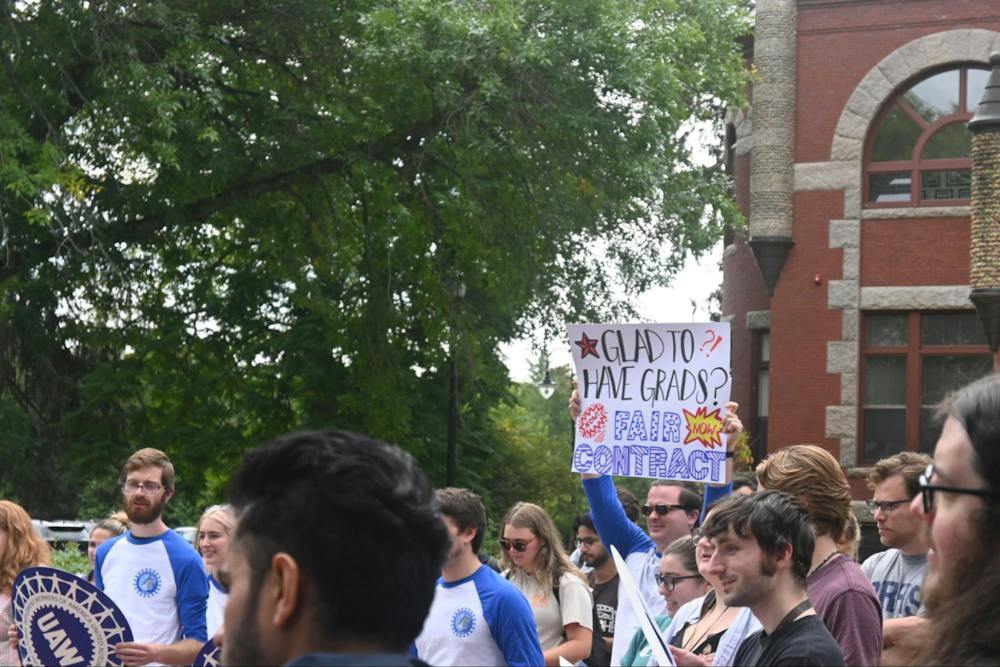
Last Thursday, the Graduate Employees United Organization (GEU-AUW) at the University of New Hampshire (UNH) marched up to President Elizabeth Chilton and Vice President Jen Riley’s meeting room to demand livable wages. After two years of negotiations, UNH GEU-AUW members have not received a contract. On Sept. 17 at 12:30 p.m., a protest was organized outside of Thompson Hall where Chilton and her cabinet’s offices reside at the heart of campus.
Local political figures such as Chair of Select Board of Hampton Carly Barry and former NH Executive Council member and candidate for governor Cinde Warmington spoke at the event in support of union workers.
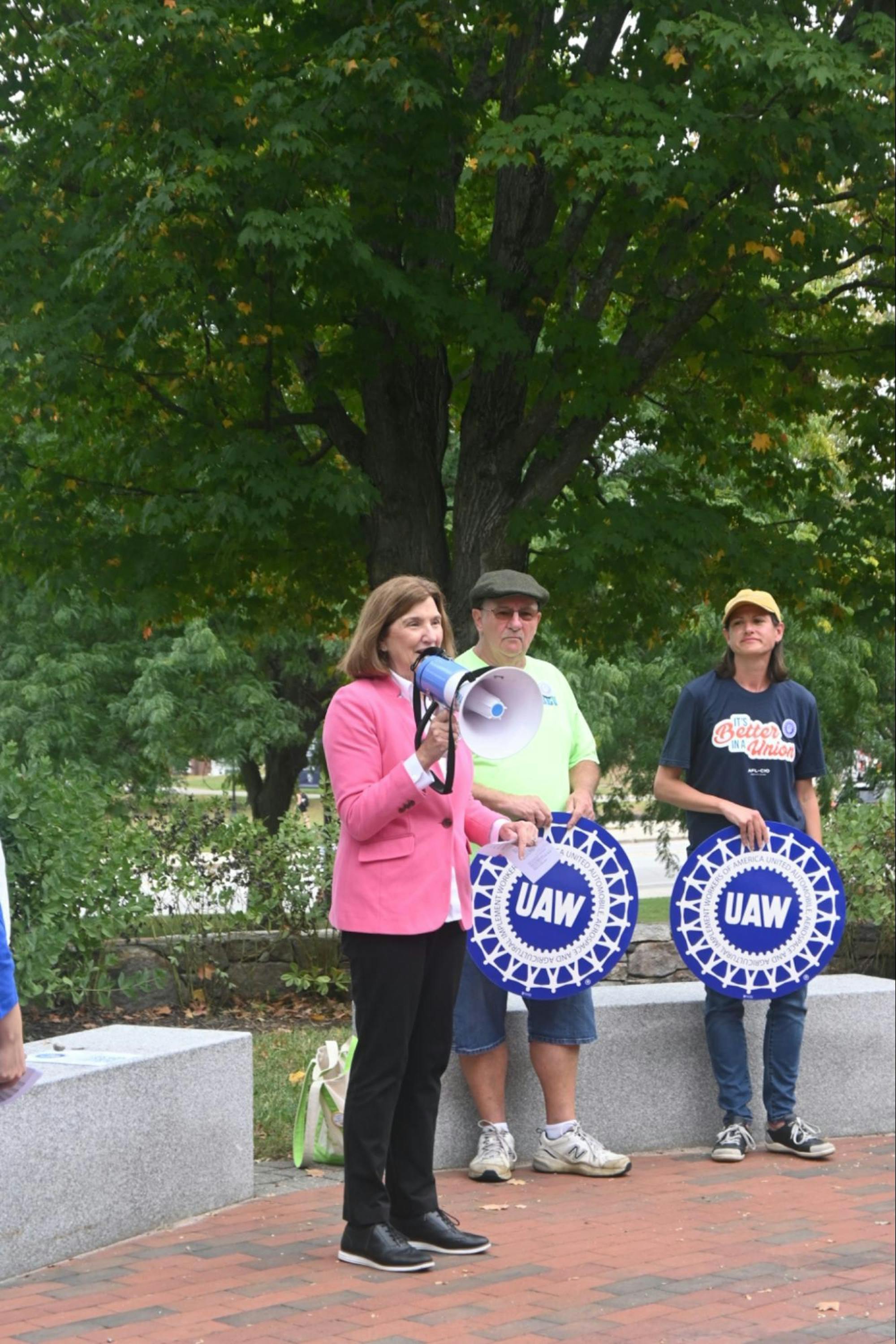
Cinde Warmington addresses the crowd. Photo Credit: Bailey Hoch
“It is absolutely outrageous that in 2026, we have people working here who are getting paid less than $25,000 a year,” said Barry. “We all know that you cannot live on that.”
As each speaker added fuel to the frustrations that the GEU-AUW members shared, the chanting became exponentially louder. Protesters recited chants from a sheet of paper.
“What do we want?”
“Better pay!”
“Two percent…”
“won’t pay the rent!” Protestors chanted.
UNH Civil and Environmental Engineering PhD student Tim Hoheneder brought passion to the T-Hall lawn, naming the many decisions UNH chose to fund instead of their graduate employees. This includes Chilton’s 12% pay raise since 2024 and placing former UNH Police Chief Steven Lee on paid leave after being arrested for a DUI.
“That could have gone to benefiting us. It could have been dental and vision insurance for us. It could have been things that materially improved our lives,” said Hoheneder, “but instead, what have they decided to do? Sit in there for two years."
Since the GEU-AUW has not received a contract, there can be no guaranteed medical or parental leave, vacation days, and most importantly, no raise in pay. Audrey Robison, a PhD student in Space Physics at UNH, explained that benefits are currently decided by their assigned advisors. These advisors grant their students different benefits, creating disproportionate work conditions.
GEU-AUW refuses to settle on a contract that does not match a livable wage in the state of New Hampshire. According to the Living Wage Calculation for New Hampshire, a single adult with no children requires an annual income of $45,607, which is over two times what many graduate students make. At the same time, UNH leadership claims they cannot make “unilateral” changes to wages or other terms and conditions of employment while “bargaining is underway.”
GEU-AUW members sat down with Chilton and handed her a proposal of their demands, insisting the university increase its offer on wages, vacation time and health insurance. Approximately 50 protestors were standing in Thompson Hall supporting the arguments by Robinson, Hoheneder and others that organized the protest. Leadership has already met with the bargaining team nine times since the end of the last academic year.
“We’re looking at the median wages of all of our employees,” said Chilton in response to their demands. As Chilton claimed UNH is doing what they can, this only grew frustration within the protestors.
“You’re offering a $1,000 raise and you just took a $68,000 raise,” said Robinson in response to Chilton. “That’s 68 times the raise that you think is sufficient for us.”
Chilton and Riley left the meeting with claims that they are actively working towards a “financially sustainable” offer for graduate students and want to come to an agreement ASAP.
“As we do with salaries and benefits across the university, UNH and the University System work to maintain competitive compensation relative to our peers,” said UNH Leadership in a separate statement.
Graduate students feel they are not valued by UNH for their teaching and research that the R1 university relies on. Interfaith Organizer with American Friends Service Committee, April Richer, predicts this will have a detrimental impact on the future quality of UNH research. Richer explained in an interview that without a fair contract, research will be negatively affected by “bias” and “outside influence” from researchers who are not compensated for their hard work. As a result, generations to come may be defeated by UNH’s shortcomings and misinformed by compromised research.
“We want to contribute to academia and what do we get for it?” Robinson asked in an interview.


