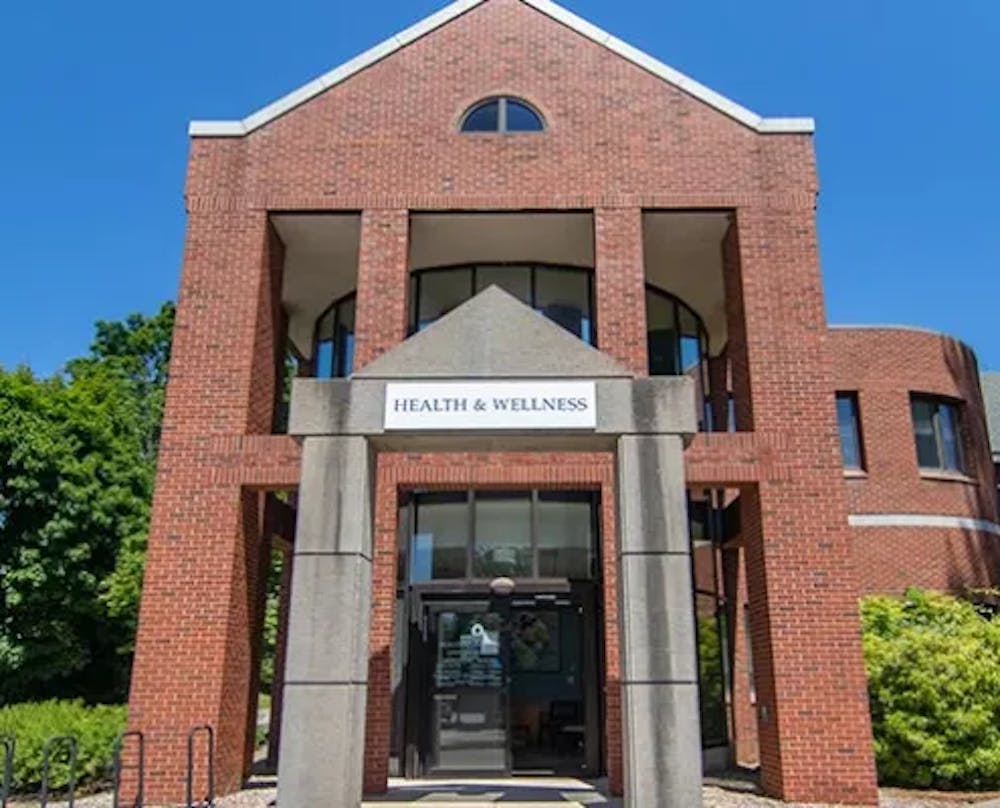
In an attempt to expand on-campus medication access and respond to student concerns, the University of New Hampshire (UNH) has partnered with Genoa Pharmacy, a Rochester-based pharmacy that offers mail-order prescription delivery for maintenance medications, temperature-controlled medications, and controlled substances.
Student concerns over medication access had grown more apparent at UNH this semester following the closure of the local Rite Aid over the summer and the limited scope of UNH Health and Wellness. The closest pharmacy for students is no longer a half-mile walk downtown, but instead a 4-mile drive down Route 4.
On Aug. 20, five days before the start of the Fall 2025 semester, the UNH community received an email titled Important Update: Prescription Access for UNH Students. The email informed them that the local Rite Aid had closed, and that the student prescriptions located there had been moved to the Walgreens in Lee, NH. The university encouraged students to have their prescriptions delivered, and highlighted that five pharmacies are available via Wildcat transit routes. No bus route to the Lee Walgreens exists.
Student-led organizations, such as the New Hampshire Youth Movement (NHYM) and the UNH Student Senate, have been at the forefront of the conversation surrounding medication access at the university, actively talking with the university’s administration and Health and Wellness. Both groups had voiced concerns that students without cars would be heavily impacted; The university prohibits freshmen from having cars on campus.
“Every single aspect of this problem affects people who are already the most vulnerable, people who need the medications that are hard to deliver,” said Josh Taranow, UNH student and Hub Co-Ordinator for NHYM. “There can’t be any dragging of feet around [the lack of a] pharmacy.”
By September, the NHYM began to demand the re-opening of the Health and Wellness pharmacy, which was closed late in the 2024 Spring Semester, in order to cut additional expenses following the university's $14 million dollar “budget reset” that January. In Taranow’s eyes, the return of this on-campus pharmacy meant "access to medications that are easy and convenient for all students.”
As of Oct. 3, all 1,240 remaining Rite Aid in the U.S. had closed in the wake of their second bankruptcy filing in two years, the result of billions in debt, increased competition, and thousands of opioid lawsuits.
On Oct. 10 in the Wildcat Weekly newsletter, UNH Health and Wellness amended their previous delivery recommendations to clarify some of the limitations. In particular, Walgreens couldn’t deliver any temperature-controlled medication or medications that were classified under the Controlled Substances Act; The latter includes ADHD medications such as Adderall or Ritalin, and are subject to strict federal regulations surrounding their delivery.

On Nov. 2, the UNH Student Senate passed a resolution about the closure of the Durham Rite Aid, which urged UNH Transportation Services to better advertise their current bus routes or implement some form of daily transportation to the Lee Walgreens. Additionally, the Student Senate voiced its support for the “search for and development of a new drug store” in Durham.
Transportation options to the Lee Walgreens had been considered. In their previously mentioned Aug. 20 email, Health and Wellness announced their intentions to develop a bus route to Lee “to provide reliable daily access for students without personal transportation.” A month and a half went by with no additional update. In October, Health and Wellness stated they were “exploring transportation options to and from Lee,” but by November, the bus route to the Lee Walgreens was officially ruled out as an option. While a short-term scheduled van service was considered as an alternative, the university decided that it wouldn’t be necessary in light of the partnership with Genoa Pharmacy.
An Instagram post from @unhwalgreentrips, who defines themselves as an “unh senior with a clean driving record,” has advertised round-trip rides to the Lee Walgreens for $15. The account was unable to be reached for an interview.
Kendall Wilson, a chronically ill UNH senior with medication needs that include a costly temperature-controlled migraine medication delivered to the on-campus mailroom every three months, had voiced concerns about the university’s delivery recommendations due to her past experiences with the mailroom and their timeliness. Her experiences happened before Health and Wellness’s October 2025 announcement that they could accept and store any temperature-controlled substances delivered to them from specialty pharmacies.
On one occasion during her freshman year, the mailroom didn’t process her medication quickly enough, and the package, which had been identified as “perishable,” reached room temperature, which meant that the medication would expire within seven days. Luckily, Wilson was only receiving one injection in the mail at a time. If the same mishap happened today, she would have to waste at least two injections, each one costing upwards of a thousand dollars in the event that her insurance doesn’t cover the refill. Her most recent delivery in October had been processed as a regular package, and not as the “perishable” package that it should have been labeled as.
Although Wilson hasn’t had her prescription reach room temperature since, she remains concerned about the mailroom’s handling of time-sensitive packages, especially in light of the Genoa Pharmacy partnership. She is worried that the pharmacy’s “discrete packaging” will result in time-sensitive packages not being treated as such.
Wilson’s concerns have been further heightened by the university's closure of the Gables and Woodside Apartment mailrooms, which serve around 1,365 students total. “You can’t have a mail-order pharmacy, but then also close two of our mailrooms.”
Except for temperature-controlled substances, which can be delivered to UNH Health and Wellness for storage if the student chooses, all prescription deliveries from Genoa pharmacy will be delivered to the UNH mailroom.
But for Wilson, medication accessibility concerns won’t be properly addressed until the university reopens the Health and Wellness pharmacy. After having seen how the pharmacy operated during her freshman and sophomore years, Wilson feels that this would be the most beneficial option for students. She remembered how helpful the pharmacy staff were and how they prioritized a “quick turnaround” on prescriptions.
The university has stated that there are no plans to reopen the on-campus pharmacy.
“We don’t want to equate a lack of an on-campus pharmacy with a lack of medication access,” said Dean of Students Micheal Blackman during a NHYM-moderated forum in early November. He said that the university’s priority is making sure students have a “straightforward way of accessing medication” via either delivery or the local Hannfords. “That can be achieved, we think, without a full-service on-campus pharmacy.”
Currently, UNH Health and Wellness stocks a variety of purchasable over-the-counter medications, in addition to 25 commonly used prescription medications for students seeking treatment at the clinic.
“Healthcare is getting very expensive. Insurance is changing, so there’s less reimbursement dollars happening. Pharmacies, like other healthcare organizations, are consolidating or closing,” said Health and Wellness Director of Education and Promotion Kathleen Grace-Bishop as she reflected on the closure of UNH’s pharmacy.
While UNH has cited many reasons for the campus pharmacy’s closure in 2024, including decreased student use, higher drug costs, and lower insurance reimbursements, one factor has emerged above the rest: financial stability. In the midst of their financial troubles, the university administration shut down the Health & Wellness pharmacy because it had been “losing money for a very long time [and] could not be sustainable.”
This financial instability was attributed to the complicated way the pharmaceutical industry functions, and frequent discrepancies between the drug manufacturers’ price and how much an insurance company will reimburse the pharmacy. In short, “not all medications are profitable,” and oftentimes a pharmacy will lose money because the insurance reimbursement doesn’t match the manufacturer’s cost, according to Health and Wellness Business Director Gregory Turcotte. Health and Wellness had estimated that the campus pharmacy was losing hundreds of thousands of dollars a year.
UNH’s pharmacy was at a further disadvantage due to a limited age demographic and the lack of a storefront, Turcotte said. National pharmacy chains, like CVS and Walgreens, see customers of all age brackets and utilize “Loss Leaders,” drugs sold at a lower cost, to entice customers in-store in the hopes they’ll buy retail goods. “Loss Leaders” act as a strategy to maximize profits and compensate for any potential losses in revenue.
“If you look at the volume of our prescriptions, a large portion of those were what the insurance company would consider loss leaders,” Turcotte said.
Due to its small size and the variety of different insurance plans they dealt with, the UNH pharmacy could not negotiate their insurance reimbursement, said Turcotte. While UNH does have its own Student Health Benefit Plan through Cigna, only around 18.6% of the total student population were enrolled in this plan last year, according to numbers obtained from the most recent Health & Wellness Annual Report.
For the fraction of students on the university Health Plan, the lack of a walkable pharmacy isn’t just an issue of access, but also medication cost. Those on the plan are eligible for “Tier One Prescription copays,” which dictate the price students would have to pay for their medication: $5 for generic, $25 for Preferred Brand, and $40 for Non-Preferred Brand. This “Tier One” pricing continues to be offered through the Lee Walgreens, according to Turcotte. All other pharmacies in the surrounding area fall under “Tier Two,” which would cost students on the plan an additional $10 per refill, regardless of drug category.
Pharmacy closures aren’t unique to Durham or the Rite Aid corporation. A 2024 study from researchers at the University of California-Berkeley, Johns Hopkins University, and the University of South Carolina found that between 2010-2021, nearly a third of all U.S. pharmacies closed. As of 2021, approximately 63,000 U.S. pharmacies remained operational. Pharmacy closures have persisted according to preliminary findings from an ongoing Ohio State University study, which found that around 7,000 pharmacies in the U.S. closed between 2022-2024. Over the next few years, this number may grow due to the planned closure of around 1,400 CVS and Walgreens locations.
While there is no one event linked to the pharmacy closure trend, the prevalence of Pharmacy Benefit Managers (PBMs) within the pharmaceutical industry has been criticized due to their financial practices that have been accused of driving up patient costs and accelerating the closure of independent pharmacies, according to the JAMA Health Forum. PBMs are companies that exist as a middleman between manufacturers and insurance companies, and hold sway over drug prices, patient access to medications, and pharmacy participation in insurance networks. A New York Times investigation from 2024 found that PBMs often paid independent pharmacies a sum that doesn’t cover the initial cost of the drug while paying pharmacies within their network more. Economic concerns about PBMs have been raised due to the fact that many of the largest PBMs are owned by companies that also own their own health insurer, according to a 2024 U.S. Federal Trade Commission report. For example, CVS Health (the corporation) owns CVS Caremark (the PBM) and Aetna (the insurer).
Due to the mass amounts of pharmacy closures, many researchers have been raising alarms over the phenomenon of “Pharmacy Deserts.” A 2025 study from researchers at Yale University, the University of Pittsburgh, and the University of California, which characterized pharmacy deserts as places where the travel time to get to a pharmacy is greater than the time required to get to a supermarket, found that 39.3% of the New Hampshire population resided in pharmacy deserts.
While the university is optimistic about the partnership with Genoa Pharmacy, it remains a new endeavor that will have to be “monitored closely,” according to UNH Director of Student Accessibility Services Scott Lapinski, who had been tasked with overseeing Health and Wellness during a transitional period this semester. “The main thing we’re monitoring is Genoa and how it actually works. Are students utilizing it? Does it actually do what we think it's going to do? Is it meeting that need?”
But Wilson doesn’t share that same optimism. She feels disappointed in the direction that the university has chosen to take.
“I’ve always loved UNH, and I have always spoken highly of UNH…but in recent years, it feels like there've been a lot of decisions that didn’t take student voices into account…it seems like they didn’t even consider the fact of reopening [the Health and Wellness pharmacy]. It seems like they’re gonna tell us to use the mail-order pharmacy and just deal with it.”