
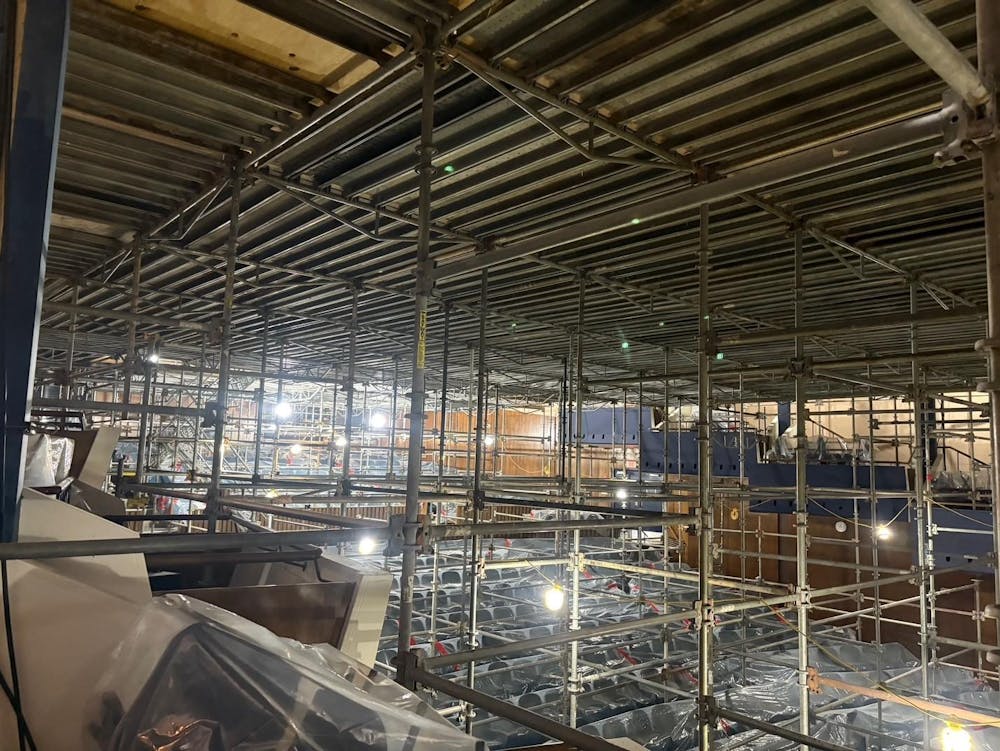
DURHAM- Students and faculty walking into the Paul Creative Arts Center (PCAC) this semester are greeted by loud drilling, bright red “DANGER: CONSTRUCTION AREA” signs plastered on the scene shop door, and metal gates outside fencing off the Johnson Theatre.
The PCAC at the University of New Hampshire (UNH) is currently undergoing a three-year life safety construction project to update the fire suppression systems and the fire alarm systems.
Since its construction in 1960, the PCAC has relied on its original fire alarm and fire suppression (sprinkler) systems. A partial fire suppression system served the Johnson Theatre wing, while the rest of the building, including in the Hennessy Theatre and the music and art wings, lacked sprinklers.
“Sprinkler systems in buildings like the PCAC at the time of its construction were only minimally required,” said Matt Mancini, UNH Facilities Senior Project Manager. “I guess the word to use is that the building's life safety systems have been deficient. So not unsafe, just not compliant to today's standards. Sort of like getting a C.”
The project includes replacing both the fire alarm system entirely throughout the building and renovating and providing new fire suppression sprinklers throughout the entire building. The Hennessy Theatre has already been completed. In the Johnson Theater, the plan is to increase the number of sprinkler heads to provide more water in the event of a fire.
As a state-owned institution, UNH is subject to the authority of the New Hampshire State Fire Marshal’s Office rather than the Durham Fire Department. However, the Durham FD are the ones that respond to all fire emergencies on the UNH campus.
Durham FD Fire Marshal Brendan O’Sullivan explained what would happen in the event of a fire at the PCAC before these renovations. “We connect to the hydrant, and we create a manual sprinkler system. But we've got to find the fire, and we've got to put water on it. We are not as good as the sprinkler system. And we're not as quick,” he said.
The PCAC has been on a priority list for a new fire suppression system for over two decades, as long as he’s been working for the fire department, O’Sullivan said.
“I went and met with Facilities. And I said, ‘Can I talk to you about changing the order on this?’ And most importantly, why I want to change the order,” O’Sullivan said. “And I did. And I'm not saying it got done because of me. But I moved it higher on the list because of the volume of people that come in [the PCAC.]”
This meeting happened 17 years ago, O’Sullivan said. As a result, the Durham FD and the UNH Facilities Division combined their priority list for buildings needing renovation. Currently, “annual inspection reports from the [state] fire marshal are reviewed with our asset management team, and asset management will rank projects for priority,” said Mancini.
Mancini also said that the UNH Facilities Division and the Durham FD work together to provide safety. “We cooperate with them and communicate with them tremendously,” he said.
In the following years, fire suppression systems were installed in other UNH buildings, including Parsons, Demeritt, and Kingsbury. Mancini says it’s now the PCAC’s turn for renovation.
Because UNH is a state university, it is required to follow New Hampshire’s adopted version of the International Building Code and the New Hampshire Fire code. “When we work with our contractors, they'll often ask, like, so where's your inspector?” said Mancini. “They often think the inspector's local. Like in most towns, they are. But because we're a state property, we fall under the state jurisdiction.”
All buildings at UNH undergo an annual fire safety inspection by an inspector from the State Fire Marshal’s Office. Since the PCAC includes the Johnson and Hennessy Theatres, which each have assembly permits allowing gatherings of more than 49 people, the building requires that an inspector visit the building at least twice per year.
Previously, the Town of Durham had its own stricter ordinances that the university also had to follow. Senate Bill 94 came into effect on July 1, prohibiting municipal amendments to the state building code.
“The state's way of looking at it was, ‘We need more consistency for contractors and architects and engineers so they're not subjected to these local municipalities’ requirements,’” said O’Sullivan.
That’s why Durham’s Fire Prevention Chapter 68, Article 3, which previously outlined the local sprinkler code, was repealed, he said.
The 2021 New Hampshire Fire Code requires educational occupancy buildings larger than 12,000 square feet to have an approved, supervised automatic sprinkler system. However, Section 13.3.1.3 exempts any buildings that were existing before the fire code was adopted.
In other words, if the PCAC were being built today, it would be required to have an automatic sprinkler system. But, its status as an existing building exempts it from that mandate. The exemption remains in place as long as the building’s use and occupancy classification do not change.
“Sprinklers are absolutely key. But you have to take into consideration- one, if they're required. And that's where you get into ‘should’ or ‘shall.’ If the code says it, it's a shall. If it's a good idea, it's a should. And I don't know anybody that doesn't agree that a sprinkler system is a good idea and it's a should,” O’ Sullivan said. “But that doesn't write the check out to put in the sprinkler pipe or to dig up the road and run the water main in.”
The PCAC renovation is classified as a capital project, meaning its funding comes from that budget. The capital projects budget is made up of a couple streams, said Mancini. UNH generally receives a small portion of its funding from the state, the lowest level of state support for any public university in the country. Student tuition, housing and fees, along with other grants, make up most of UNH’s funds and contribute to the capital projects budget.
“Because we're under such financial challenges these days, there's certainly more you could do in the building, but to be responsible with budgets, we’re doing what we can,” said Mancini.
UNH communicates with the state and their priority list so they know that the university is on top of things. The state is aware that the university has more work to do than the resources currently allow, Mancini said.
“Again, no building is occupied or used that is deemed unsafe. If it was unsafe, they would shut us down immediately,” he said.
Charters Brothers are contracted to do the construction and renovations.
The project began this summer with renovations to the Hennessy Theatre. The Hennessy Theatre’s renovations were completed before the start of the 2025-2026 academic year so that theatre students could have at least one space while the Johnson Theatre undergoes construction.
“It's very difficult to lose the space during a semester where we have to be very creative to figure out what to do with our productions and our labs. Because the theatre is our lab,” said Szu-Feng Chen, department chair and professor of theatre and dance. “But because they communicate early enough, we were able to plan around it and find other ways to still serve our students for this semester.”
The department has taken the lab requirement, or the practicum, off of the course schedule for students because it cannot be completed without a full theatre. “We really need the theatre back,” Chen said. “Otherwise our students, they don't have a space to work. And we cannot do our productions.”
One of their productions this year is taking place in an alternative location: Hamilton Smith Hall. However, the production, an adaptive theatre piece, is limited in regard to scenery, lighting, and other features that require an actual theatre.
“We can sell a lot less tickets and then it also limits the type of shows that we can do, because there are some shows that just demand a larger set or a larger amount of people in the cast, so you can only do certain things with the amount of space you have,” said Olivia Krick, a senior theatre student.
The PCAC is an integral part to the university’s connection to the community, said Ben Cariens, Department Chair and Associate Professor of Art and Art History. “We have exhibitions that bring the community in,” he said.“And in those ways, we have a certain obligation and greater need to make sure that those are good experiences and obviously safe experiences.”
After the Johnson Theatre is completed, fire sprinkler installation in the rest of the PCAC will pause at the end of J-term and resume in Summer 2026, beginning in any remaining spaces in the music wing. The final phase of sprinkler installation is scheduled for Summer 2027.


