
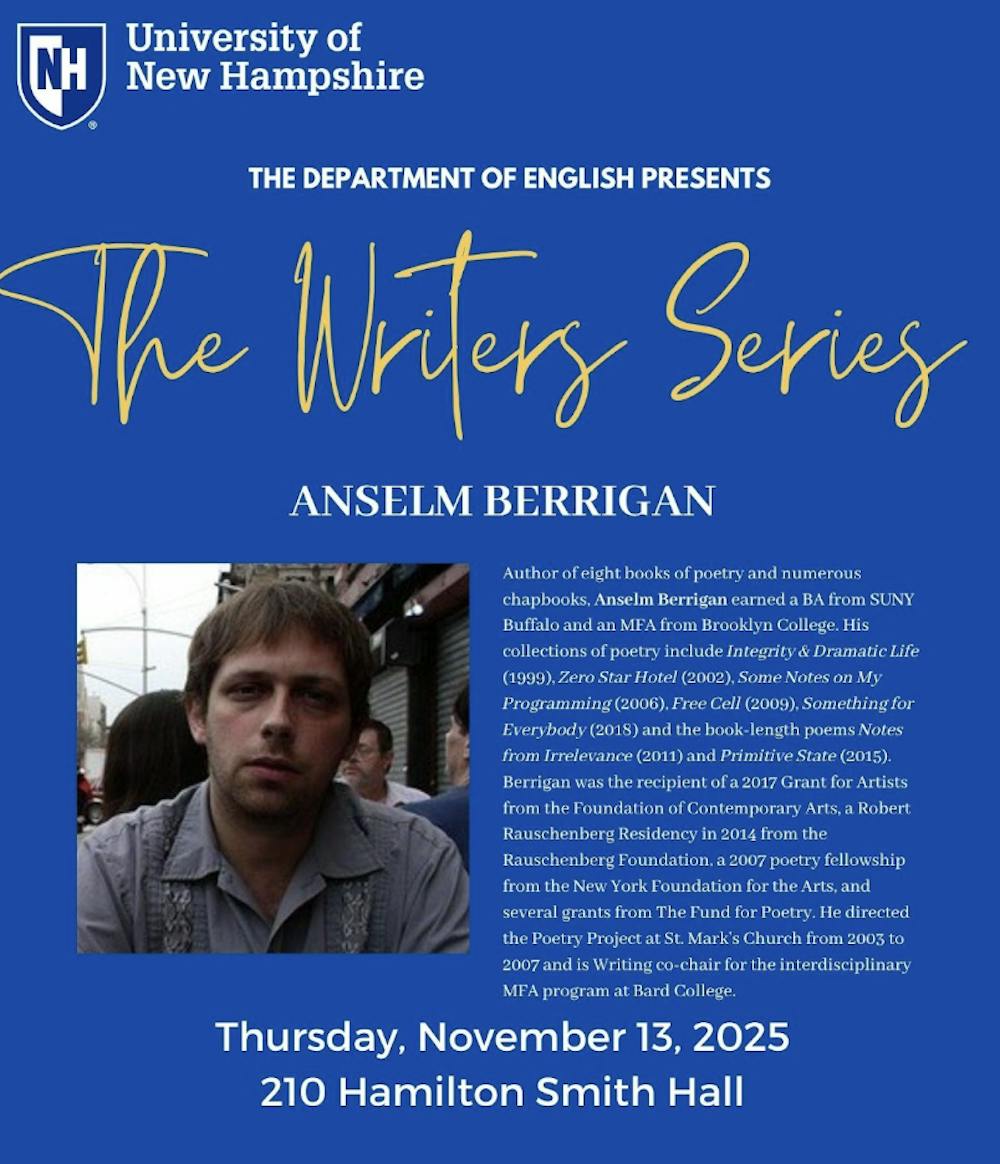
In a continuation of the Writers Series at the University of New Hampshire, poet Anselm Berrigan brought humor, political criticism, and self-introspection to a Thursday-night reading attended by student writers seeking the kind of insight and inspiration that only someone deeply immersed in the creative field can offer.
Anselm Berrigan, a poet from a renowned literary family that includes his parents, Ted Berrigan and Alice Notley, has published and edited numerous collections, served as poetry editor at The Brooklyn Rail, taught writing at Pratt Institute and Brooklyn College, and is currently a speaker in the Bagley Wright Lecture Series in Poetry, where he will deliver a multi-part talk titled Pregrettably Yours: On Being Influenced.
Kevin Le, a poetry MFA student, introduced Berrigan and his career accomplishments. “It is very important that students hear a wide array of poets speaking their own poems and hearing that music,” Le said in a pre-event interview. “Also, having the interview process after with the poet to understand craft and the literary landscape.”
For most of the event, Berrigan read from his collections Pregrets and his most recent publication, Don’t Forget to Love Me. The reading concluded with a Q&A, which opened up a wide-ranging conversation about his approach to developing poetry collections, engaging with personal subject matter, and the influence of living in New York City.
One audience member asked what inspired him to become a poet. “When I went to college, I had no idea what I wanted to do. I did not write poems,” Berrigan said. “I was just really interested in words—their arrangements, their sounds, what you could do with them. I started keeping a notebook, and one day I broke a line instead of writing straight across the page. It might sound like I’m lying, but I felt a full-body high from doing it.”
David Blair, a lecturer in English and core poetry faculty at UNH, expressed his admiration of Berrigan’s poetry and emphasized the importance of attending readings. “Most poets write for the page and also for the ear, so the experience of hearing poetry read really conveys things that we might not pick up while reading—tone, emotion, pacing, and things like that,” Blair said. “One of my students in Introduction to Poetry, a linguistics major, told me about talking to Anselm afterwards about language, and I could see she was taking the experience of hearing him read and talk, and that was making her redefine what she knows and is learning in her classes.”
In a post-event interview, Berrigan discussed similar topics, covering his journey to becoming a writer and the life experiences that have shaped his poetry.
When asked about mentors and inspirations, he highlighted the influence of familial figures, especially his father and mother.
“I read my father's poems before I started writing because he died when I was ten years old and reading his poems was a way to keep getting to know him,” Berrigan said. “Some years after I started writing I realized I'd had certain instincts in place without knowing it because I'd read his poems when I was younger— that you could be funny, use collage methods, move around on the page, risk sentiment, and other things. My mother was an even more primary influence because of the simple fact that she loved to talk about poetry and so we were always talking about it along with everything else. Her approach to performing her work and her general ethos as a poet and person have been very impactful.”
His most recent collection, Don’t Forget to Love Me, was a central focus in both the reading and the academic learning of MFA poetry students. When asked what inspired this collection or how it differs from earlier works, Berrigan pointed to the circumstances that guided its creation and the framework of his final collection, which is the longest work he has ever submitted for publication.
“A large part of that book was written during the 2020 lockdown, so in some ways the inspiration was simply to keep going, and then maybe I also felt a kind of civic responsibility to get down whatever I could about this strange terrible collective experience we were having across the planet,” Berrigan said. “The book is also a kind of sprawl, deliberately, because I had a lot of poems that were quite different from one another, including two long poems, and I wanted to make a space that could allow them all to coexist and breathe together.”
To Berrigan, poetry is an inexhaustible source, and poems can come from an “endless source of angles,” allowing writers to explore a wide range of emotions and confront the significant events of their lives, a process that can be both joyful and exhausting.
“I believe that through poetry, I’m taking part in a collective endeavor that predates writing,” Berrigan said. “Once you start making work you become part of the whole historical fabric of humans doing this, in every era, in every culture—that keeps me going and makes it rather easy to keep going.”


