
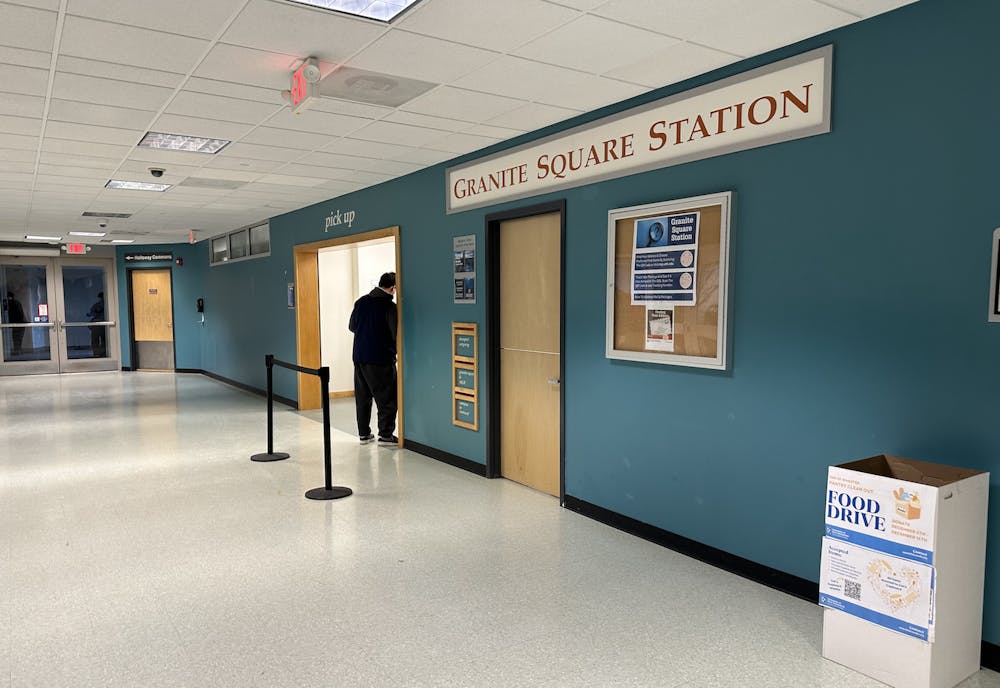
On a typical afternoon, the hallway outside Granite Square Station feels less like a student center and more like airport security. A slow-moving line, a stack of waiting packages, and a steady stream of students checking their phones for updates.
“Once, I think I waited over a week after my package was delivered to get any sort of confirmation from them,” said Emily C., a sophomore psychology major. She added that notifications often arrive just minutes before closing. "If the line’s long, it’ll barely move for 20 minutes. They need to be more organized, and it just makes everything inconvenient."
For hundreds of University of New Hampshire students, scenes like this have become routine since the university closed the Woodside and Gables mailrooms this fall and rerouted every package to the Memorial Union Building.
What looked like a logistical reshuffling turned out to be the latest sign of deeper budget cuts rippling through UNH. The decision to close the two apartment mailrooms and consolidate package pickup into a single location has created long lines, staff strain, and student frustration across campus, with little warning or explanation.
“It’s really affected the amount of packages we receive,” said Jesse Long, a senior and lead staff member at the MUB mailroom. “At the beginning of the year, we were super swamped. The more packages, the more mistakes will be made. It can get overwhelming, and we won’t get it done in the day.”
Long has worked in the mailroom since her sophomore year. This fall, she says, the change has doubled the workload. Four processing stations run during the busiest times, with only two students on customer service, while hundreds of packages arrive daily through FedEx, UPS, and Amazon.
“We got notice during our training that it was all coming together into one station,” she said. “No one knew why; we just found out. It was late notice for everyone.”
Students who once relied on the convenience of nearby mailrooms now have to trek across campus to the MUB, often waiting a long time just to pick up a package. For workers and residents alike, the frustration is shared.
“I’ve definitely had people, my friends in Gables, say it’s annoying,” Long said. “They have to come down to the MUB and wait even longer. It’s a drag for everyone because it’s further away and takes longer for all their packages.”
It's clear that the mailroom closures were not driven by logistics; they were driven by money.
Andy Petters, UNH’s Director of Housing, confirmed that the Housing department’s overall operating budget has been reduced by about 25 percent between Fiscal Year 2024 and Fiscal Year 2026, a decrease of roughly $2.9 million.
That shortfall, Petters said, led to a cascade of tough decisions.
“The total student labor budget line (hourly/wage student staff) for Housing has been reduced from $608,466 in FY24 to $433,513 in our current fiscal year,” Petters wrote. “We’ve had to make several tough decisions in the last three years regarding how to provide services with fewer resources. This included no longer having service desks at Gables and Woodside apartments.”
Those “service desks”, the mailrooms, were among the first cuts to go.
The change also eliminated several on-campus student jobs. Long said the MUB has hired more workers to help handle the surge in volume, but not enough to make up for the loss.
“Most of the time, students can’t do more than they’re already working because of classes or other commitments,” she said. “We definitely had to hire a lot more people, but there’s still stress around finishing everything.”
For many students, the most frustrating part wasn’t the consolidation itself; it was the lack of communication.
UNH sent an August 20 Student Life email to all students with general campus updates, but the mailroom closures were never mentioned. The only formal notice residents received came in a July 31 message sent directly to Gables and Woodside students, just weeks before move-in. That short window left little time to prepare.
“I chose this building and took out a loan to live here with the promise that getting my mail would be convenient,” said Matthew Polino, a junior theatre education major and Woodside resident. “It was only after that I was told we wouldn’t have that mailroom. The school hasn’t made up for this in any way, and we’re just expected to accept it.”
Polino’s frustration stems from the significant cost difference between traditional residence-hall housing and the university apartments at Woodside and Gables.
According to UNH’s published Food & Housing Rates for 2025–26, a double room in a residence hall costs $4,481 per semester ($8,962 per year), while a double-occupancy apartment in Woodside or Gables costs $5,253 per semester ($10,506 per year). That’s roughly a 17 percent higher cost each semester, yet the convenience of an on-site mailroom, once part of what distinguished apartment living from residence halls, has now been removed.
Polino said package delays have become noticeably worse this semester. He described lines that stretch down the hallway and email notifications that take days instead of hours.
“Last year, the mailrooms were already busy,” he said. “This year it’s so much worse. The lines just to get packages go down the hallway, and the wait for the email to go get my package is taking days.”
A TikTok posted on Oct. 14 shows how overwhelming the MUB mailroom has become. The 5-second clip, recorded by UNH sophomore Lucy Olson and captioned “deadly,” shows a line of students stretching down the hallway. The post quickly circulated among UNH students, with 11.2k views and 36 comments.
“Was actually in that line for like 15 minutes the other day,” one student wrote.
“Watching this from the mailroom line,” another added.
Another summed it up: “smh it ruins my whole day.”
The GSS initially extended its hours at the start of the semester to help offset the closures. In September, the mailroom operated Monday through Thursday from 9 a.m. to 8 p.m., Friday from 9 a.m. to 6 p.m., and Saturday from 10 a.m. to 2 p.m., with Sunday closed.
However, the hours were changed mid-semester again. According to the GSS website, the current schedule is Monday through Thursday from 9 a.m. to 6 p.m., Friday from 9 a.m. to 4 p.m., Saturday from 10 a.m. to 2 p.m., and closed on Sundays.
The sudden change also highlights one of the central issues behind the mailroom consolidation: students often learn about service adjustments only after they’ve already taken effect. The reduced hours became another example of how communication around the closures has been inconsistent and unclear.
Polino also questioned how the university handled the announcement.
“The announcement was sudden, and right before the year started,” he said. “It seems like they’ve made people’s lives harder and then just moved on like nothing happened.”
When Petters was asked who else was involved in the decision, he pointed to UNH’s complex administrative structure. Printing and Mail Services, the unit that oversees Granite Square Station, now falls under Hospitality and Campus Services, a division that also manages dining, catering, and conferences.
However, Dorrie McClintock, Executive Director of Hospitality and Campus Services, said her department “wasn’t involved in the decision” to consolidate the mailrooms.
“Hospitality and Campus Services wasn’t involved in the decision to consolidate the Woodside and Gables mailrooms into the GSS at the MUB,” McClintock said in an email. “We just took over operation of the GSS this fall.”
That timeline means Housing made the call before the new management structure was in place, leaving questions about how the decision was coordinated and communicated across departments.
The back-and-forth has made it challenging to trace accountability, a reflection of the institutional maze behind what might seem like a small operational change.
Meanwhile, at Granite Square Station, the daily reality of that decision plays out behind the counter. Long, the lead staffer, says her team is doing its best to keep up with the surge. Even with additional hires, she said, the volume is relentless.
“During peak times, like the beginning of the year or now, around Halloween, we need at least 24 hours to process everything,” Long said. “The more packages, the more things can go wrong. We’re all students, so I tell everyone if there are packages left over, it’s okay. They’ll get it tomorrow.”
Despite the strain, Long and her coworkers say most of the frustration is directed at the wrong people. “Students get annoyed, but I just hope they know it’s not our fault,” she said. “It’s because of the budget cuts.”
For students like Polino, the closures are more than an inconvenience; they show a growing disconnect between students and administrators. “I think what people are most upset about is the way they went about it,” he said. “They didn’t ask students, they didn’t really tell us, and now it’s everyone’s problem.”
He believes the mailrooms should reopen eventually, but with better planning and support.
“It should be easier for students to get hired for those jobs, and they shouldn’t be expected to do too much with too little help,” he said. “GSS is already understaffed. They need to give people motivation to work there.”
As of early December, UNH has not announced plans to reopen the Woodside or Gables mailrooms. Housing officials have not indicated whether the closures are temporary or permanent.
“I hope it’s temporary because it’s really annoying,” Long said. “I don’t think it’s that deep, but it does suck for people who live at Gables and Woodside. It just takes longer for everyone, and it’s further away.”
But as the semester comes to a close, one thing is clear: the inconvenience isn’t disappearing. From long lines to delayed notifications, the closures have altered a routine that students once took for granted.


