
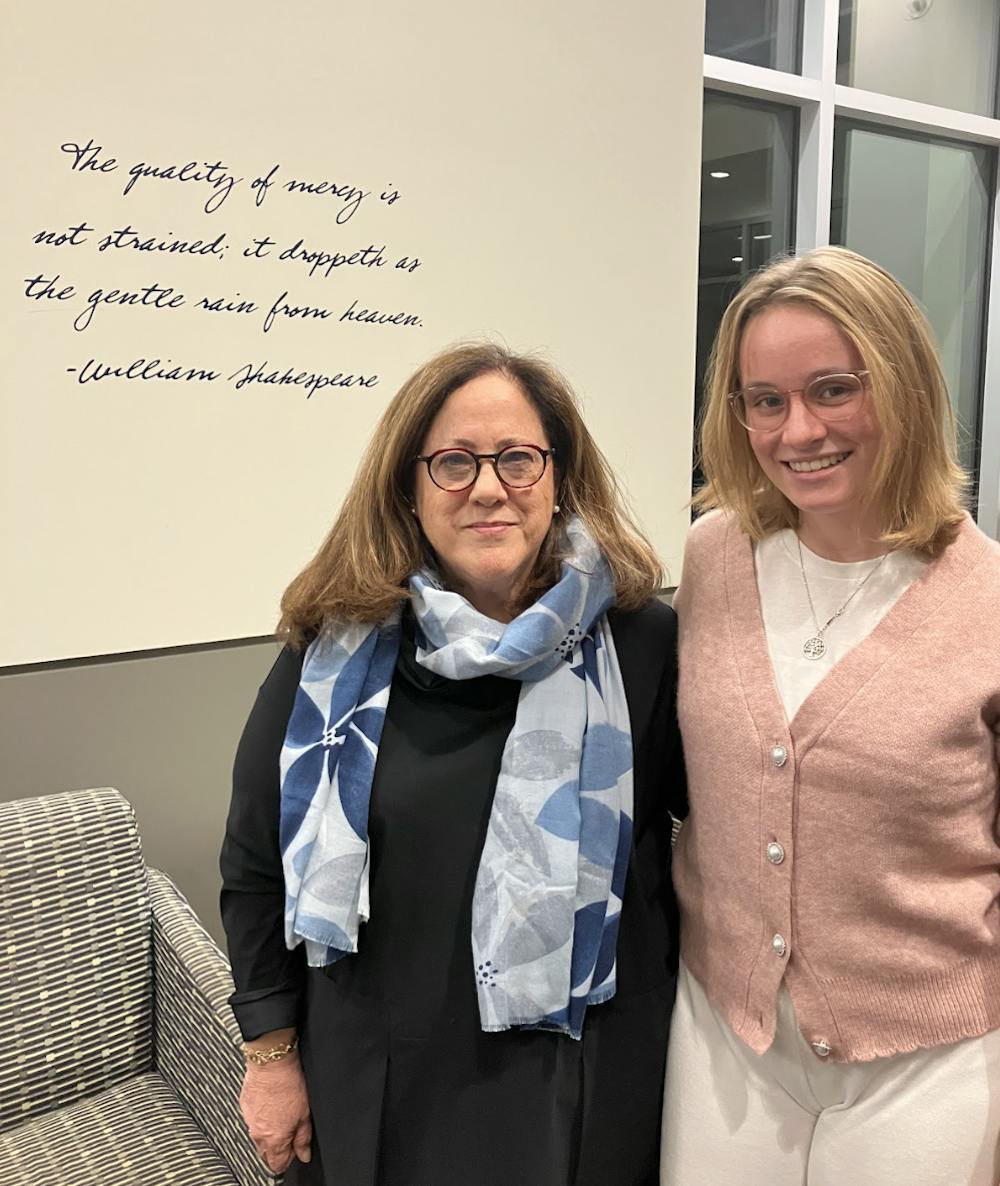
On Thursday, Nov 13, as part of the Heilbronner Lecture series, the University of New Hampshire invited Carole Zawatsky, the CEO of the Tree of Life, a community organization dedicated to uprooting antisemitism. The Hans Heilbronner lecture series honors the memory of Hans Heilbronner, deceased professor of history at UNH, and centers around the Jewish community, as well as remembering the victims of antisemitic attacks.
This year, Zawatsky came to share her experience following the 2018 Pittsburgh synagogue shooting. What is today known as the deadliest antisemitic attack in the United States impacted not just the eleven victims, their families, and the neighborhood, but the entire nation.
“Antisemitism is a problem to all Americans. It can’t be a problem just to Jews,” said Zawatsky.
It was Oct. 27, 2018, when the perpetrator entered the Tree of Life synagogue in the Squirrel Hill neighborhood of Pittsburgh, PA, and opened fire – killing eleven victims and wounding many more. It was reported that he carried ammunition for moving on to another location afterwards, but was apprehended and is now serving on death row. He acted out of far-right beliefs and replacement theory, a belief that Jewish people were ‘stealing’ jobs and houses, thus replacing those who he deemed had more rights to them.
Regarding his conscience, he commented that he felt no remorse.
Sharing this, Zawatsky almost teared up. While she was not present at the time of the shooting, she interacted and became close with many of the victims’ family members. She is now actively engaging in efforts to establish a new sanctuary for the Jews in that community to feel safe again.
Zawatsky was not the only one who was emotionally affected during the presentation, though. A heavy silence fell over the whole room when she showed pictures of the objects of faith that were harmed, one of which was a glass window that was one of two of its kind, displaying the history of the American Jewish community. They are now being repaired, but prayer books and children’s artworks are forever destroyed.
Zawatsky started undertaking the establishment of the new sanctuary for the Jews of Squirrel Hill at the same site as the Tree of Life Synagogue; the first thing she did was remove all the objects and even walls that bullets had touched.
“It’s supposed to be a sanctuary, a safe haven,” Zawatsky said, “You’re not supposed to have a prayer book that literally has the word ‘Peace’ on it, shot through with bullet holes.”
According to her, if she really wanted that new building to provide comfort and safety, nothing in there could be a physical display of the violence that took place there, because that would normalize living with and doing nothing about it. This was unacceptable to her.
Instead, the incident will be remembered in the education center within the new Tree of Life sanctuary, as well as the courtyard serving as a memorial for the eleven victims.
The building will also house a museum, a worship space, a library, and a cafeteria, providing opportunities for people to come together and build a community. Regarding the design, Zawatsky is passionate about there being a lot of space and light, signalling peace and hope, while never forgetting.
In her presentation at UNH, she certainly succeeded with that. An attendee reported that they felt deeply impacted when she encouraged a minute of silence to read the names of the victims out loud. Another commented feeling grateful that attending the lecture reminded them of how it was “a community event, and not just an event that happened with this one synagogue.” It “brought together people of various faiths.” That attendee was referring to the outreach of Muslim communities directly following the event.
In Jewish tradition, bodies should be buried soon after death, and the Islamic Center in Pittsburgh raised enough money to pay for all the funerals of the victims within forty-eight hours. Further, on the same night of the attack, the neighborhood orchestrated a vigil that is annually repeated and still fully attended seven years later.
In the following days, countless people, not just Jews, anonymously left gifts and little objects on the victims’ graves. Examples being engraved stones and a cross-stitch that reads “You will be remembered”. This demonstrates two things: the strong support the people in Pittsburgh have for each other, and that they are all survivors.
The horrible event is still not fully processed by the people it impacted, but it’s a process of growth, and they are emerging brighter than before.
The 2018 synagogue shooting is a story of resilience. One of the direct survivors swore she was never going to set foot into that building again, but after seeing pictures of it in a panel, she supposedly took a deep breath to say, “I walked out of that building alive. I will walk back in alive.”
Antisemitism persists and has been on the rise in recent years. Consequently, promoting values of peace and respect are not just ideals Zawatsky is fighting for, but a goal for many people. From this, projects like the Light Education Initiative, an outreach program to educate High Schoolers on genocide, the Holocaust, and Human rights, were created to bring greater awareness and civil discourse to Pennsylvania High Schools.
Every event that addresses the issue of antisemitism, or any kind of discrimination, is relevant.“Where antisemitism is, all kinds of identity-based hatred takes root. When people don’t feel safe, then that in its nature is a threat to our democracy,” said Zawatsky
The organizers of the lecture were delighted to see so many people stay for the subsequent reception in hopes of learning more. During the presentation, the audience hung on to every word in a respectful, at times shocked, silence.
A conclusion that can be drawn is that bad things will always happen, and they tend to have two outcomes. They can either rip people apart or connect them.
The 2025 Heilbronner Lecture Series appeared to have had the latter effect, bringing people together in collective solidarity, as well as shared enragement. Ultimately, the goal of reducing antisemitism and promoting values of peace and belonging is to show that we are not all that different. We are all humans.
Despite the victims and painful consequences it caused, the 2018 Tree of Life synagogue is a great example for humanity and the reality of community across different religions and groups of people. The Pittsburgh community never forgets. Every year, the candles will be lit as a way to express solidarity and support for those affected by antisemitism. Every year, that annual act speaks to the same promise that the anonymous cross-stitch left on a victim’s grave conveyed: “You will be remembered.”


