
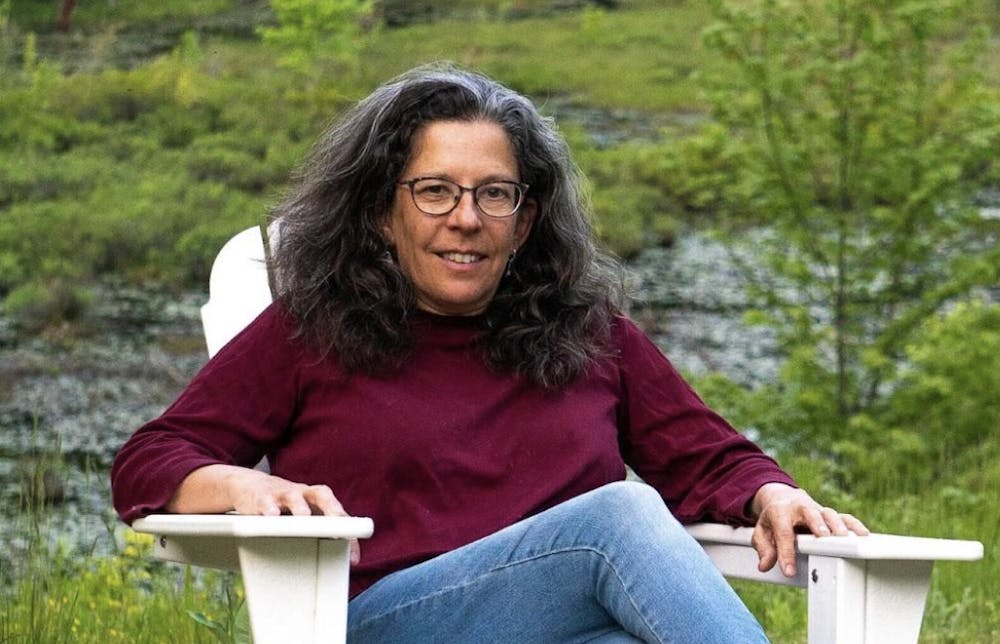
From her home in Chester, New Hampshire, Midge Goldberg devotes her retirement to writing, sharing her literary knowledge with others, and participating in readings across New England — the epitome of a writer’s dream.
Midge Goldberg has published several poetry collections, including Flume Ride, Snowman’s Code, To Be Opened After My Death, and, in 2022, edited the anthology Outer Space: 100 Poems, featuring outer-space-inspired poems by writers across history. She has also published a children’s book, My Best Ever Grandpa, illustrated by Valori Herzlich, which celebrates the wonderful connection between a grandfather and grandchild.
She is best known for her poetry, but this central passion has lent itself to other forms, such as essays and novel writing. On Friday, October 10th, she joined a current UNH journalism student in a Zoom interview, touching on a wide range of subjects, from her beginning experiences in the professional world to the unusual steps of her writing journey. Through her thoughtful responses, Midge emphasized the value of continuous learning and offered encouragement to those who discover their creative passions later in life.
Youth and Undergraduate Years
“When I went back to look at it, I actually took more English classes at Yale than I took economics classes.”
Midge was an avid reader during childhood, drawn to fiction books in particular, but she was not exposed to poetry and did not consider herself a writer. As an undergraduate, she attended Yale University as an economics major but found herself strangely completing more English courses. Though she was interested in literature and exploring the classics, she never fully registered her love for English, or at least never connected it with a viable career path.
Midge’s balance of skills in creative and analytical areas, subjects that are often seen as conflicting, is proof that students don’t have to confine themselves to a single learning path in college. Exploring different fields and learning opportunities can open unexpected paths and passions.
Working for a Living
“I taught myself how to program computers, and I became a programmer. When the web came along, I taught myself how to do that and became a web programmer.”
In connection with her career, Midge discusses the importance of adaptability, explaining how she took advantage of early opportunities and connections and evolved with the changing needs of the industry.
After graduating from Yale, Midge moved to Boston, expecting to work in urban planning, but instead stumbled upon an internship and eventually a career at a video production house. This role was built on her involvement in Yale’s Film Club and foreshadowed her future passion for storytelling.
Throughout her time there, Midge adapted to emerging technology to help the production house save money, teaching herself to program computers and, later, to apply those skills as the internet, social media, and digital marketing emerged. Her experience shows how people in creative industries often need to develop new skills in order to keep pace with change and ensure efficient production.
She provides an example for students who want to incorporate creativity into their careers and still be able to support themselves in the future.
First Student in the UNH MFA Program
“I just wanted a grounding in the [poetry] canon,” Midge said. “For me, my focus was more on the learning. It was great to learn from workshops, but I also had this whole other community outside of school.”
Midge began writing poetry at age 36, inspired by the works of Rhina Espaillat, a poet she later became acquainted with when joining The Powow River Poets, a group of accomplished New England writers founded by Espaillat in 1991. She first came across Espaillat’s collection Where Horizons Go while taking a writing course focused on short stories and poetry, and was especially moved by a poem about challah, the traditional Jewish bread, which resonated with her own Jewish heritage.
In 2004, Midge began her graduate school journey in the UNH master's program, seeking to fill the English gaps she missed during college and learn about classic poets, specifically mentioning Homer, Ovid, and the Romantics as subjects of interest.
Shortly after she enrolled, UNH founded its MFA program, and Midge was part of the first group to join, committed to further exploration of creative writing and poetry. During her time, she mentioned taking transformative classes with several retired professors, such as Michael Ferber, Charles Simic, and Mekeel McBride, and also participated in poetry groups and workshops outside of the UNH community. She was the university’s first MFA graduate, receiving her degree in 2006.
Inspiration of Place and Nature
“Since I came to New Hampshire, I’ve always had a vegetable garden. I have chickens, and I love baking, cooking, and canning— it all makes me feel so grounded. Living here gives me a sense of place that I hope comes through in my poetry.”
Midge was born in New York and grew up in Florida, so she had no experience with the oddities of New England. When she moved to New Hampshire, there were many new things for her to adjust to— a standout memory was the first time she was faced with the adventure of walking across a frozen lake— but she found, after time spent living among nature and connecting with a grounded way of life, that setting had an enormous impact on her poetry.
This is a prominent theme among generations of poets, from William Wordsworth, who celebrated the beauty and spiritual power of nature, to Robert Frost, who used his experience in New England to express themes of the human experience.
Advice for Young Poets
“You get an idea and you write it down, but then go back and look at it tomorrow, go back and look at it the next week. It’s that revision process that really hones a poem.”
As a formalist poet, meaning she writes with defined meter, form, and rhyme, Midge highlights the importance of studying classic poetry, not only to gain inspiration but also to build knowledge of form and poetic devices. She compares devices such as meter and rhyme to tools in a toolbox: useful when needed, even for poets who focus on free verse, which does not follow a fixed rhyme scheme or metrical pattern. Midge also noted that Mary Oliver, a renowned American poet known for her vivid portrayals of nature, began as a formalist, publishing a book called Rules for The Dance: A Handbook for Writing and Reading Metrical Verse, before becoming known as a free verse poet.
Midge has a simple writing routine: sit down and spend time writing, even if nothing good comes of it. Although she believes in the helpful assistance of a writing group, she advises that writers focus first on setting time aside every day to read, work on their poetry, and revise. These are the only essential components of the writing process— writing groups are there to elevate pieces, not to create them.
She has a “what have you got to lose” philosophy when submitting writing to magazines, contests, or even for publication, and acknowledges the importance of taking risks as a writer while not taking rejections personally.


