
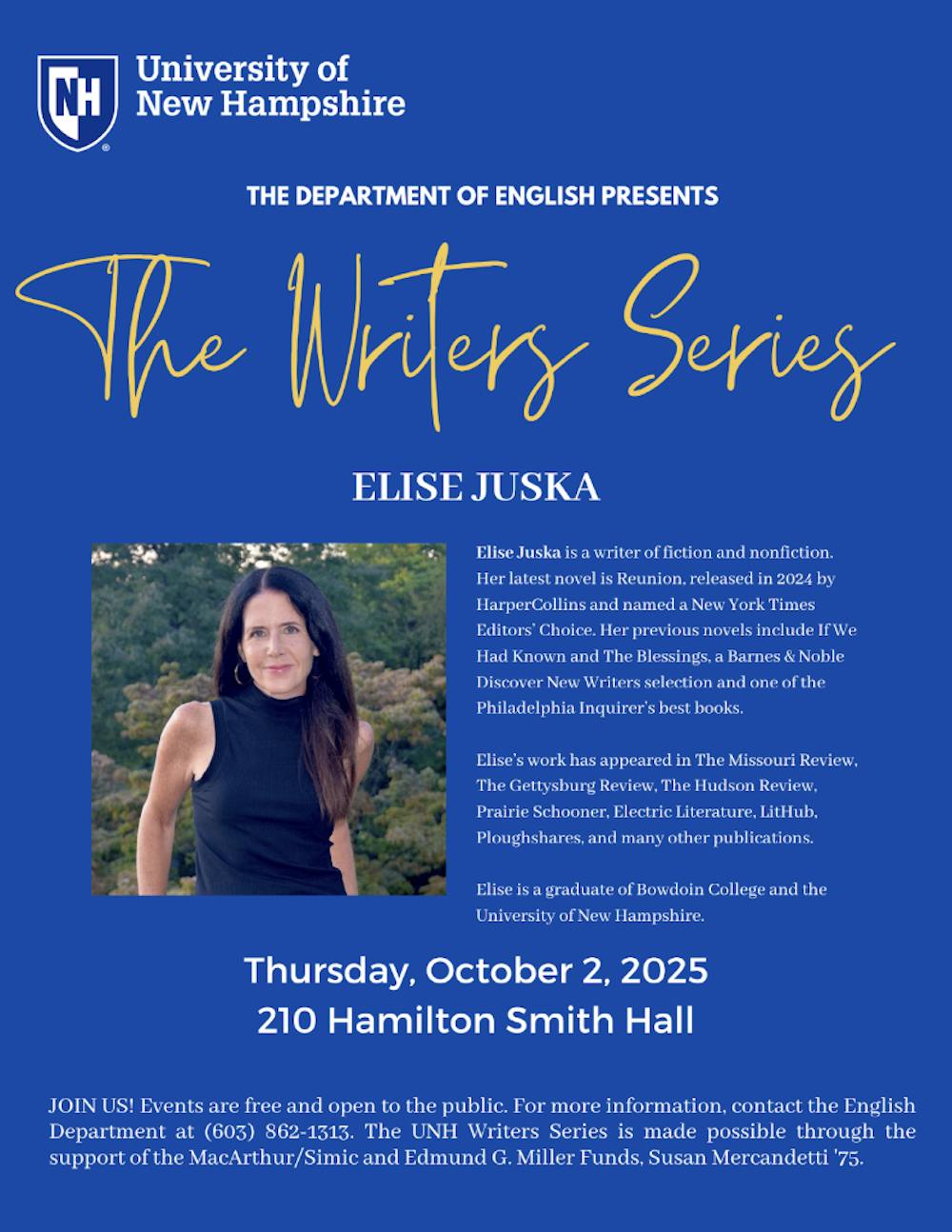
On Thursday evening, students and community members welcomed Elise Juska, a celebrated author and alumna of the UNH MFA program, for the first segment of the Writers Series in room 210 of Hamilton Smith Hall. During the talk, Juska wove readings from her acclaimed novels, Reunion and The Blessings, with reflections of her journey as a writer.
Thomas Payne, associate professor and director of UNH’s Writing MFA program, organized this year’s Writers Series. These events showcase writers of fiction, nonfiction and poetry. Payne said his goal is to encourage students in their pursuit of writing and to present it as a viable path for those who may be skeptical.
“We remind the visiting writers that in the audience are student writers, both MFA and undergraduate, and that they would love to learn from the published writers how they became writers," Payne said. "It's not the goal of the series to have writers just read but rather to give something to the students that is inspirational about what it is to become and live the life of a writer."
Payne began the event by addressing the audience of aspiring authors and sharing insight to the MFA program. Tabitha Soper, a graduate student in the MFA writing program, followed with an overview of Juska’s work, highlighting her novels Reunion and If We Had Known, along with her accomplishments in writing and teaching.
In a pre-event interview, Juska expressed the importance of “perseverance and patience” as a writer and recalled the many stories and novels she wrote that never took off or remained unread. During her talk, she emphasized this theme by sharing an anecdote about the photo album she kept as a young writer to collect rejection slips from magazines and journals.
“That photo album was so important to me as a young writer; even though I was collecting rejections, I didn’t find it discouraging,” Juska said. “Rather, it felt energizing, to be in conversation with the world I wanted to be a part of, to see the blank rejection slips gradually start coming back with little notes of encouragement or invitations to submit again.”
Juska spoke on the value of age and experience as a writer, as well as the moments in her life that inspired stories. For example, her first teaching job at UNH as a professor of First-Year Writing gave her the idea for her novel If We Had Known, a story centered on the struggles students face in silence and the unspoken responsibility teachers have to care for them. She also described her writing approach, saying she tends to “write with no plans” and commonly structures her novels to show the ripple effects of life-changing events, switching between multiple perspectives.
Near the end of the event, Juska allowed for audience questions, which ranged from advice on character development to acquiring a writing style. Because Juska’s novels often draw on her own experiences and the people around her, one student asked how to write autobiographical stories without overstepping the boundaries of others.
Juska clarified that although she may begin with a character inspired by a family member or a friend, she allowed space for these elements to take on a life of their own rather than limiting herself to the truth. She advised that it is best, if unsure, to allow others a chance to read the novel and give their opinion or feelings on the matter. Ultimately, she said, it is unpredictable how people will respond to her stories.
Out of the many subjects discussed in her speech, the overall writing lesson of the event was one of resilience and revising. “For me,” Juska said, “the drafts of stories and two novels I wrote that didn’t end up published were still purposeful and even necessary, for I learn from them; they helped me write the novels and stories that eventually did end up out into the world.”
The next segment of the Writers Series is on Oct. 23 with nonfiction author Chelsea Conoboy.


