
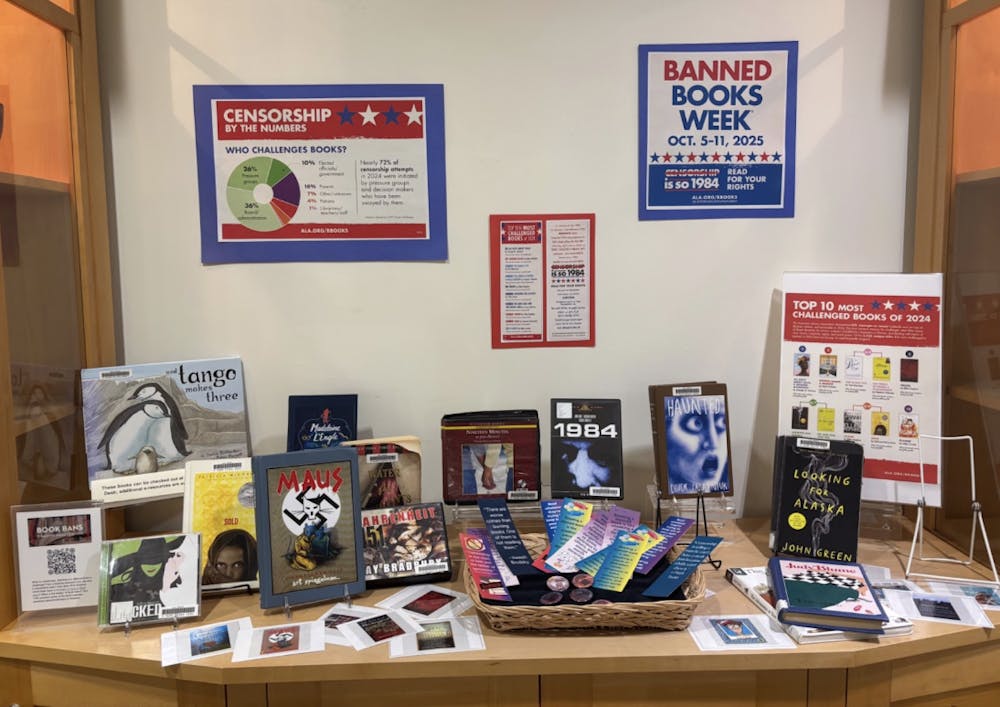
The University of New Hampshire’s Dimond Library recently organized a display for Banned Books Week, a nationwide event running from Oct. 5–11 that highlights frequently challenged literature and draws attention to growing concerns of censorship.
This display featured stacks of banned or challenged books, including prominent examples like Orwell’s 1984 and Bradbury’s Fahrenheit 451, alongside a whiteboard for students to write down novels that have impacted them. Some posters were ranking the books that are most commonly challenged and others detailing the groups of people who typically target literature, the main forces disproportionately being school boards, district administrators and pressure groups. These groups organize campaigns to remove books they believe to be sensitive, dangerous or offensive, commonly attributed to sexually explicit or violent language.
Nancy Miner, a service specialist at the Dimond Library, created the banned books display to show her support for literary freedom. “Intellectual freedom is often taken for granted in our country, and it is valued in libraries,” Miner said. “It’s our job to provide access to information and that access is increasingly being challenged, so in a learning institution our students should be aware that others are trying to limit access to ideas.”
Joining her in defense of open access to books is Kimberly Sweetman, dean of the Dimond Library, who is adamant in her position that “everyone should choose whatever they want to read.”
“Reading is an inexpensive and easy way to learn about different perspectives and cultures, which helps people develop empathy,” Sweetman said. “Removing a book from the library effectively removes the opportunity to learn about that topic. More than that, books should not be removed from libraries or schools based on individual opinions.”
Banned Books Week has been recognized in libraries across New Hampshire, including the local Durham Public Library, which featured two displays following the theme “Set your imagination on fire, read a banned book,” complete with flame-themed decor.
“Every child deserves to see themselves in a book,” said Sheryl Bass, director of the Durham Public Library. “Censorship in schools also reduces access to differing perspectives on issues that kids will be exposed to whether they have access to reading materials or not, thereby reducing their ability to think critically.”
Students on campus are also concerned about potential limitations on their access to materials that have exposed them to different ways of thought and expanded their perspective. Katie Sullivan, a senior English teaching major and founder of the Little Library Club, emphasizes the importance of fighting for targeted books, while acknowledging that there are some acceptable limits for school libraries with young impressionable readers.
“The purpose of raising awareness about banned or challenged books is to ensure that, even if books being banned is out of our control, the stories and their values do not leave silently,” Sullivan said. “Starting conversation and recognition around banned books inadvertently gives the books a new platform.”
Beyond campus, many citizens in America worry about the meaning behind the movements to restrict access to reading materials and question the infringement on First Amendment rights. Non-profit groups such as PEN America, which advocates for freedom of expression in literature, and the American Library Association, which promotes library education, have demonstrated their adamant defense against book bannings by gathering clear data and making the subject a central aspect of their campaigns.
In recent years, there has been a noticeable trend among the types of books that are targeted, often featuring themes of race, sexuality, or institutional power. While school libraries experience a higher rate of book removals, there has been a rise in attempts to challenge books in public libraries.
Displays like those at Dimond Library and Durham Public Library remind students and the public that access to diverse stories is both a privilege and an essential component of freedom. Libraries play a crucial role in preserving these ideas and in resisting censorship.


