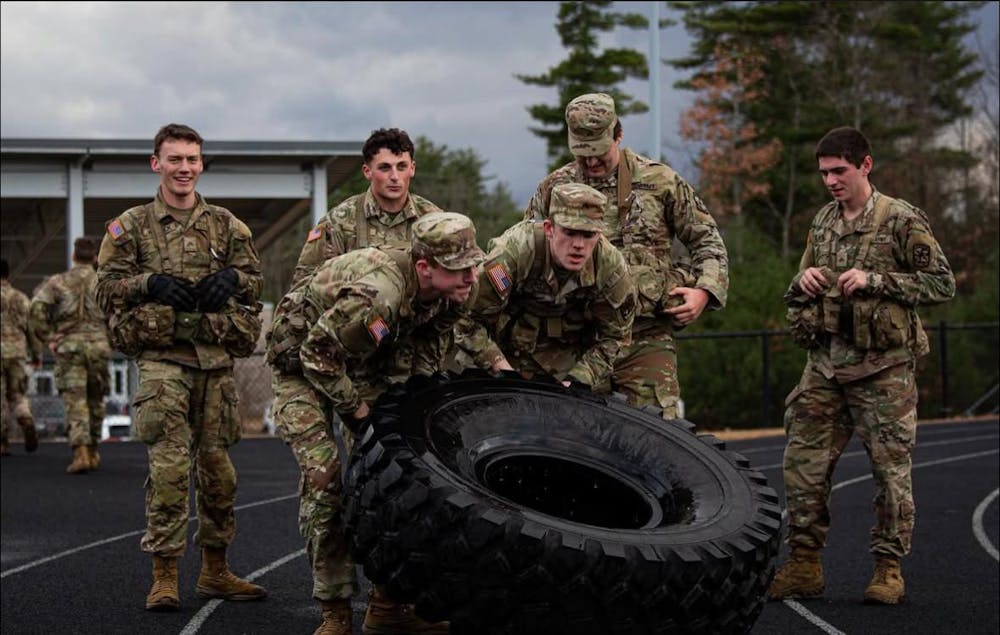
Since 1885, the University of New Hampshire’s (UNH) Reserve Officers’ Training Corps (ROTC) program has been running and building a strong foundation within the Durham community. The UNH ROTC Army and Air Force program, made up of 100 students, focuses on management skills, goal-setting, time management, problem-solving and teaches students how to be strong leaders and citizens.
Back when the ROTC program was first established at UNH, the Army and Air Force branches were combined, and cadets participated in roughly the same activities instead of having a divide between the Army and Air Force specialized activities. The Army and Air Force ROTC branches are typically found in more rural places, such as Durham, which is why other Navy and Marine Corps branches are not a part of the UNH program. The Navy and Coast Guard programs are more concentrated in urban areas, such as Boston, so there wasn’t as much consideration in adding the Navy branch to UNH’s ROTC program since there were other universities in close proximity, such as Maine and in Boston, that offer those programs.
According to the Army recruiting operations officer Joseph LaPlante, “at UNH the mission is to have them [cadets] graduate with an academic degree and commissioned as an Army second lieutenant. They are commissioned on a Friday and then graduate on the Saturday, and once it happens, they have the option to either go full-time active duty for three to four years as a lieutenant or to serve all their time in the reserves and National Guard. Most people go to the reserves because they already have jobs lined up after college or don’t want to leave the area they are in.”
LaPlante stated that in their early years, cadets get as much experience as possible so they can know where they want to go, and most decide after their first year of being in the program. In the reserves, cadets work part-time at a base, are able to live near home and have other jobs that are not associated with the military. About 75% of the cadets go on active duty. Active duty attracts cadets for reasons such as pay, travel and experience. During active duty, army cadets work full-time and can be deployed at any time.

Around 25 percent of cadets come into college with a ROTC scholarship from their high school through the National Scholarship Process, which is applied to minimize the cost. The UNH ROTC provides benefits for students, including attending Airborne School, Air Assault school, the Nurse Summer Training Program (NSTP) for nurse cadets, internships, and cadet summer training. According to LaPlante, what entices most members to join alongside character development is the scholarship benefits, which include either 100 percent of the tuition paid or $10,000 per year for room and board and $1,200 per year for books. Cadets also receive a $420 monthly stipend.
“There has been a proposal at UNH to make all cadets pay in-state tuition, which would entice a lot more cadets into the university. This is mainly so they are able to prioritize their academics and be prepared for the reserves or active duty after graduation,” said LaPlante.
The daily routine of a cadet is three mornings during the week from 6 to 7 a.m., where they do physical therapy, strength exercises and run. Once a week, cadets have a 90-minute class on leadership and management in addition to a tactical lab at Thompson's Farm.
The lab prepares cadets to go to Advanced Camp in Fort Knox, Kentucky, a leadership camp needed for graduation, for four weeks during their junior summer. The tactical skills learned there are land navigation, map reading, patrolling, how to move soldiers and squads through wooded areas, and a lot of fitness. All Army cadets need to pass the Army Combat Fitness Test, which is six events of endurance and strength-related exercises. On the 600 points you can get on the test, women typically score between 450-500, and males average 550.
Although the ROTC program can look or sound intimidating by the level of commitment, for freshmen ROTC typically takes up to nine hours, which consists of three hours of PT, four hours of tactical lab and 90 minutes of class.
“The main priorities of the cadets are academics, which is the number one goal, and then their next priority is sports (clubs, division, intramural), third priority is the Army ROTC, their fourth priority is any clubs or extracurriculars they want to do,” said LaPlante
Each semester, around three to five students from ROTC study abroad, but do not do ROTC activities when they’re away. When cadets return from studying abroad, they make academic and training plans to catch up on what they missed. LaPlante shared that the ability of time management seems to be the main struggle of most cadets, but many quickly adjust to their new routine after a few weeks and seem to find a good balance between the program and other college activities.
Support and donations from the UNH community and alumni allow for an award ceremony, recognizing roughly 50 cadets, at the end of the year. On April 25, the program held a Commander's Cup, which is a tactical leadership competition where all companies of cadets come together and compete in tactical training. The ROTC program at UNH has played a crucial role in many of the cadets' lives and prepares them mentally and physically for the military demands upon graduation, said LaPlante.