
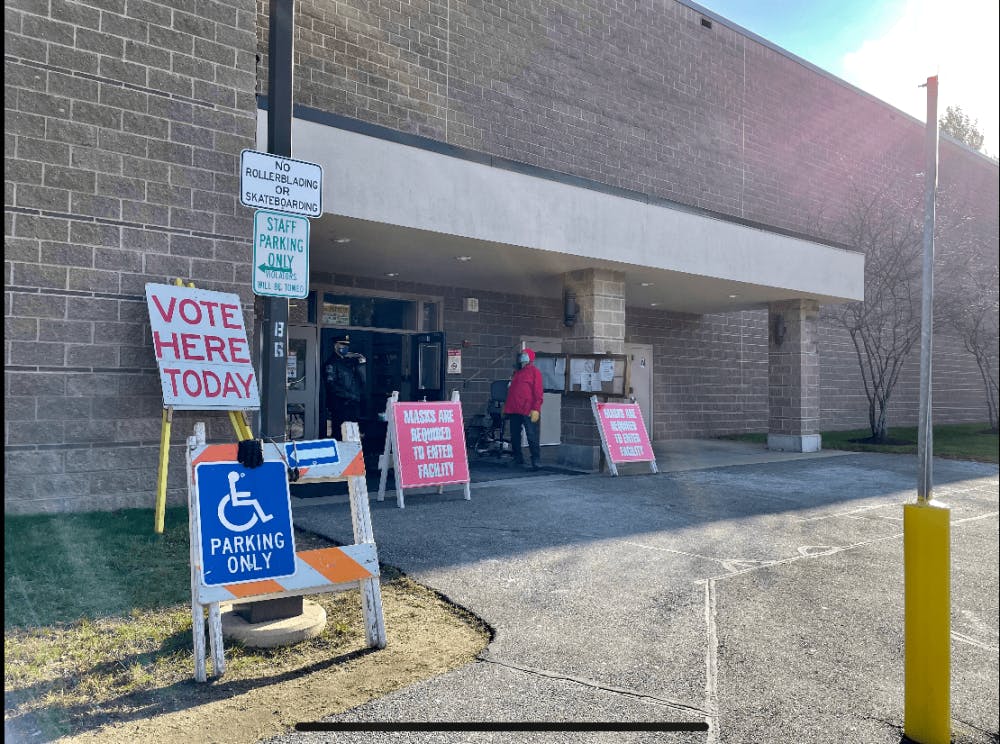
On April 3, 2026, Governor Ayotte signed into law New Hampshire House Bill 323, “requiring the presentation of a government-issued photographic means of identification in order to vote.” Previously, New Hampshire university or high school students were able to verify their identity at the polls with their issued student ID. As of June 2, 2026 this will no longer be a valid form of ID at polls across the state.
Many New Hampshire residents and advocates believe this is simply a tactic to suppress young voices in state elections.
“I think our generation is a group of people who have grown up in a very polarizing time when it comes to politics. Everybody has really strong opinions and wants to make those opinions heard,” said Sophomore Isabella Cannon, one of three Hub Leaders at UNH’s chapter of the New Hampshire Youth Movement. “I think older politicians realize that, and might recognize that it might not particularly bode well in their favor, and so they put in these voting restrictions to help their perspective and make sure their agenda gets pushed forward.”
This is not a new legislative move by any means, either. Olivia Zink, Executive Director of Open Democracy, noted that each year between 50 and 100 election law-related bills are introduced.
Under Governor Sununu, House Bill 1569 went into effect on November 11, 2023, stating you can’t do the affidavit and requiring residents to approve citizenship, identity, domicile identity (address), and age when registering to vote in the state. Last year, Governor Ayotte signed Senate Bill 287 into law, which as of September 30, 2025, requires voters requesting an absentee ballot to show proof of identity with a photo ID as well.
Now, HB 323 has been signed into law, with the next local election being the state primaries this September.
Rachel Deane, Durham Town Clerk/Tax Collector, advised that students can call on their town clerks, as they are the most accessible election officials. Students can attend office hours or reach out to them by phone or email to ensure proper documentation before heading to the polls. As of right now, electronic copies of government-issued ideas are also accepted. For out-of-state students, a family member can send a photo of their passport or other valid form of ID, and students can show election officials at the polls a photocopy, which is accepted as proof of US citizenship.
Robert Sullivan, a member of the Durham Democrats, noted America’s long history of voter suppression and how bills, such as HB 323, just make it harder for certain groups to identify themselves at the polls. “I think it's directly intended to reduce the voting block of students, and it's being falsely sold as this is about voting integrity, voting controls, and voting quality. But the reality is, it’s just erecting a barrier,” said Sullivan.
Sullivan also noted that this bill could have a real impact on the less engaged, less motivated young voters across the state. If they deem gathering proper documentation too “hard,” that’s even more individuals opting out of voting in these local elections. For those who do not have a driver's license or other valid ID, buying a passport for over $100 to validate your identity, then turns into a poll tax of sorts.
Zink said, “Municipal elections tend to have lower turnout than general elections, but I really do hope that everybody feels empowered to participate and knows how important it is and why that matters. I think participation is so important, and I've never understood why there is lower turnout for local elections, because those are the decisions that are made that impact you the most.”
Laura Manson, a member of Oyster River Rise, recalled that last year, in a 2025 local election, because of HB 1569, 255 voters were turned away from the polls. And 2026 is looking to be a much bigger election year, especially among young voters, as HB 1793, or the ‘campus carry’ bill, has an overwhelming amount of New Hampshire students in opposition.
Many sponsors and supporters of HB 323 claim this bill was necessary to keep the state’s election integrity and secure the polls. In response, Manson said, according to the Heritage Foundation, in the last ten years, there have only been 22 cases of fraudulent voting convictions in New Hampshire.
“Two-thirds of students are voting Democrat. So if they could disenfranchise college voters who mostly vote Democratic, then that leaves them in power longer to do more damage, right?” said Manson.
As of right now, New Hampshire has a Republican Governor and a Republican majority in the New Hampshire House and Senate. “I think it’s a last gasp effort to try to restrict voting before they lose the New Hampshire House,” said Sullivan.
Sullivan shut down the argument that voting in the US is fraudulent. Local elections are run by real people. Community members are volunteering their time and working hard to keep these elections running smoothly.
“If the Republicans in this next election don't have a good argument, and people don't agree with their political ideas, their policy ideas, they shouldn't win if they don't have the support,” said Sullivan. “But it is possible to win with low support, but good voter suppression. That's what happens in Russia.”
Many in opposition to this bill believe that high school students will be impacted the most, as they are just reaching voting age, but many still do not have a driver's license.
Representative Heath Howard (D-Durham) spoke about the disenfranchisement of students on campus, and those who do not have a car in New Hampshire. So the only valid form of ID on them could just be their student ID.
“This is something that we see, especially so for disabled students, and that's something that's very important to me personally, because there are times where oftentimes disabled students will be less likely to have a driver's license than normal able bodied students, and that is a very concerning aspect of this type of legislation where every single student in New Hampshire, if they go to a public K through 12 school, they will have some sort of photo identification provided by that school,” said Howard.
Senator Daniel Innis, also Professor of Marketing and Hospitality Management at UNH, does not believe that HB 323 violates any New Hampshire voting laws. “Clearly, students had a government-issued ID to get the student ID. But since the student IDs have so little information, they really do not work to verify residency or even age,” said Innis.
Senator Innis also proposed a question: “Should students, and thousands of them, be allowed to vote on issues that will affect local taxpayers if they then leave after a year or two?”
This bill raises this question, because Innis stated that many voting decisions can have long-lasting or even permanent impacts. “Understand, however, that students can vote here. Even if we disallow student IDs to vote, just bring your drivers license, sign the affidavit that you live locally, and vote. Easy enough,” said Innis.
Rep. Howard advised that UNH students can also gather proof of domicile through Webcat. “If you live on campus in a dorm, you can actually go through the web portal and show your dormitory address right online, and that is a valid proof of domicile. So that's a very easy and straightforward way of doing things.”
New Hampshire is also a state that allows same-day voter registration, so voters can show up to the polls with proper documentation to register and vote at the same time.
“The right to vote is fundamentally important and students should register before election day so that they know they're on the rolls And if they don't have a government-issued photo ID, there are groups willing to help them,” said Zink. “If you need a ride to the DMV or a ride to the town clerk’s office, let folks know, and they will try to find resources to help them.”
Updated information and guidance on student voting in New Hampshire can be found on the Open Democracy website, as well as the Secretary of State’s website. Additionally, on Wednesday April 29, Congressman Chris Pappas will be in UNH’s Memorial Union Building in room 338/340 from 11 am-3 pm for a “Pop-up Passport Fair,” assisting students with passport-related issues, whether they are applying for one or renewing one. Students must bring all proper documentation to the event.


