
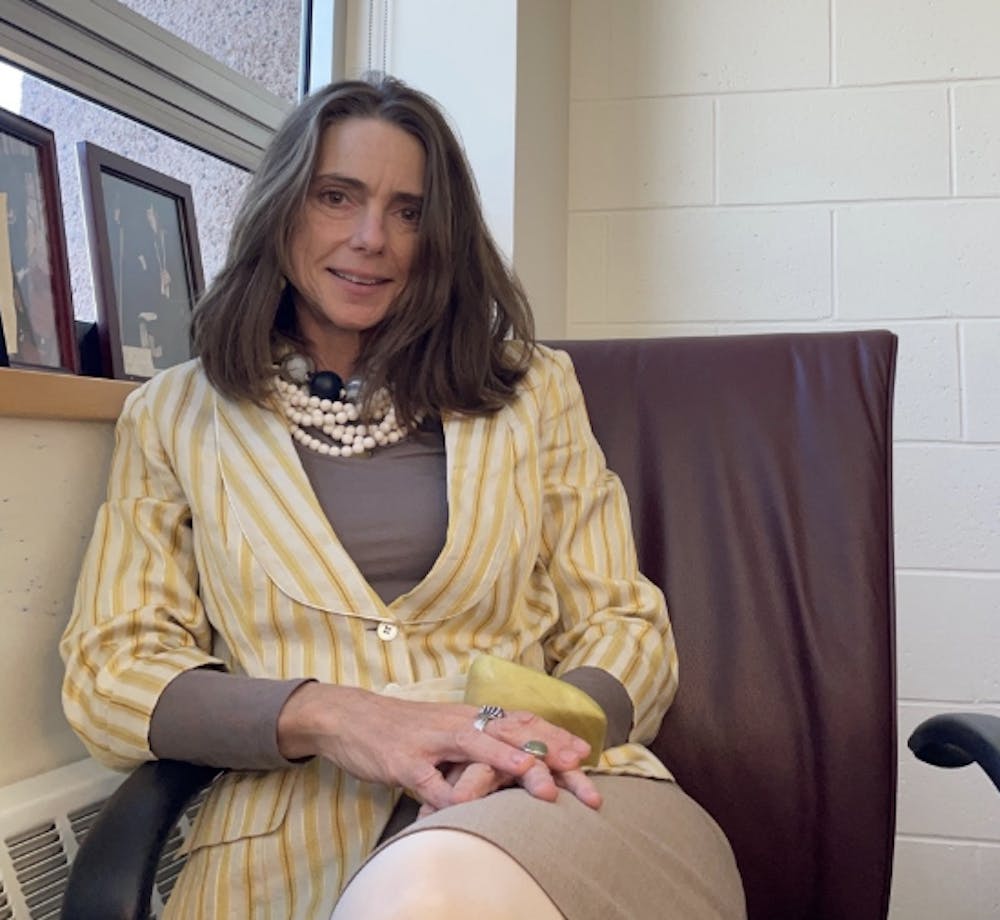
Dr. Elizabeth Caldwell begins her lecture on disorders of development on Thursday, March 5, despite many absences. “Today’s attendance is 24, that's half the class. And I know why,” she said. The class followed an exam, which Caldwell believes explains the students’ lack of motivation to attend.
“Don’t think I’m scolding you because you’re the better ones who came to school today,” said Dr. Caldwell. She looks around and giggles as she reassures the present students. Her students’ faces light up with grins and murmurs of relief as she instructs them to take out a piece of paper for an extra credit opportunity, followed by the ripples of closing laptops after the professor orders students to stay off their devices.
Dr. Caldwell, Senior Lecturer of Psychology, values her students’ learning experience by cultivating a productive and engaging classroom while continuously addressing the dangers of advanced technologies such as AI and other relevant societal issues. At a previous lecture in early February, Dr. Caldwell presented a thought-provoking take on artificial intelligence and cell phones to her Research Methods in Psychology class.
“That was one of the best classes of my life, because I didn’t get through the whole lecture,” Dr. Caldwell continued. “Once they started looking at this image, that’s when I couldn’t move on.”
She was referring to Paweł Kuczyński’s “Perfect Garden,” a painting that depicts a garden landscape made out of a sea of human heads, the majority looking down at their cellular devices. A few scattered heads are looking up, soon to be eliminated by a lawn mower. Dr. Caldwell connects her topics to paintings, culture, and art as a way of deepening students’ understanding.
Dr. Caldwell lectures on her writing-based classes on AI intentionally, as she is aware that students commonly use AI to rephrase their writing or write papers for them in their entirety. She attempts to prevent the usage of AI to the best of her ability.
“When it comes to education, there’s no place for a robot to do the thinking or the preparation for exams, or the difficult effort-based work it takes to write,” said Dr. Caldwell.
The professor predicts future generations will lack what she calls “intellectual infrastructure,” or the idea that the next generation won't have enough intelligence as a population to support each other. Dr. Caldwell consistently encourages independent thinking inside and outside of the classroom. Many students appreciate her teaching methods, finding her efforts in the classroom to challenge their learning.
“I really felt like she merged science and creativity in a way that I found really beneficial,” said Jemma Glen-Wixon, Pre-Med Intern at Wellesley Family Care and former student of Dr. Caldwell. Glen-Wixon described how the professor would reach beyond traditional styles of teaching psychology. She recalled in-class activities such as making neurons out of Play-Doh and writing reaction papers on movies.
“Scientists, teachers, artists, doctors, politicians, writers, they collectively form a tapestry of your society, and if all of our young people are getting a bachelor’s degree and they’re not past their high school years, what kind of society are we trying to build?” asked Dr. Caldwell.
Philosophy professors studying AI raise similar concerns as Dr. Caldwell, discussing how human society can ethically incorporate the tool into civilization. Since scientists are paid for writing research journals, Dr. Caldwell argues they will struggle with income if AI takes over the writing process. “Even in the best-case scenario,” Edwards continues, “we have this kind of post-scarcity world where there aren’t that many jobs that the humans need to do and we can all just spend our days trying to figure out what to do with our lives.”
Dr. Caldwell believes that in the field of psychology, AI threatens psychological research the most by minimizing creative thinking.
“In order to be a scientist, you need a creative mind. You have to think about things that haven’t been thought before," said Dr. Caldwell.
Before Dr. Caldwell decided to focus only on teaching, she researched and taught simultaneously. She explained how teaching was more enjoyable with less writing to do. Despite this, she misses her time researching but enjoys teaching research.
“Aggression is really my first love for research,” Dr. Caldwell said. In 2010, Caldwell and David C. Riccio, a Professor Emeritus of Kent University, conducted an experiment involving aggression, testing how Long-Evan rats would react to alcohol reward under stress. The study, “Alcohol self-administration in rats: Modulation by temporal parameters related to repeated mild social defeat stress,” found that humans’ behavior to drink under stress does not apply to animals.
Along with fears of society’s intelligence and purpose dwindling, Dr. Caldwell predicts that AI will exacerbate discrimination in the workforce. She explained that in the professional world, society is already on an uneven playing field for marginalized groups such as women and people of color.
“We shrink 100 jobs down to two; the two males get the jobs,” Dr. Caldwell said.
On her office door, Dr. Caldwell proudly displays prominent black women in history such as Rosa Parks, Bell Hooks, Lelia Wanick, Wangari Maathai, and more, as a way of. representing their continued significance. Dr. Caldwell prioritizes women’s equality, considering feminism in all aspects of her life. From her desire to read more female authors to mindfully teaching topics related to gender. Considering teaching the biological differences between males and females, Dr. Caldwell concluded her disorders of development lesson with a clip from the sitcom Everyone Loves Raymond, in which the character Ray Barone blames his wife Debra’s strong emotions on Premenstrual Syndrome (PMS). Through this TV episode, Dr. Caldwell exposed her students to the harmful rhetoric of dismissing women’s emotions with their menstrual cycle, hoping they would understand the inaccuracy and satirical humor.
“Rather than ignoring or shying away from this aspect of teaching this topic, Dr. Caldwell found ways to hold space for and examine it tastefully,” said Ash BarNoy, an alumnus and former student of Dr. Caldwell.
Beyond her concerns over A.I. and gender discrimination, it is clear that Dr. Caldwell holds her connections with students, colleagues, and past professors close to her heart. In her office, dozens of black picture frames of professors, students, and more fill the desk. A bulletin board with additional photos includes a headshot of BarNoy, who only spent a single semester with Caldwell in Fall 2024.
“Dr. Caldwell is proof that there’s no amount of time too small for a professor to impact a student’s life, and I am incredibly proud to have been taught by her,” said BarNoy.


